
OpenAI Decisions API: The AI That Answers in Verdicts, Not Essays
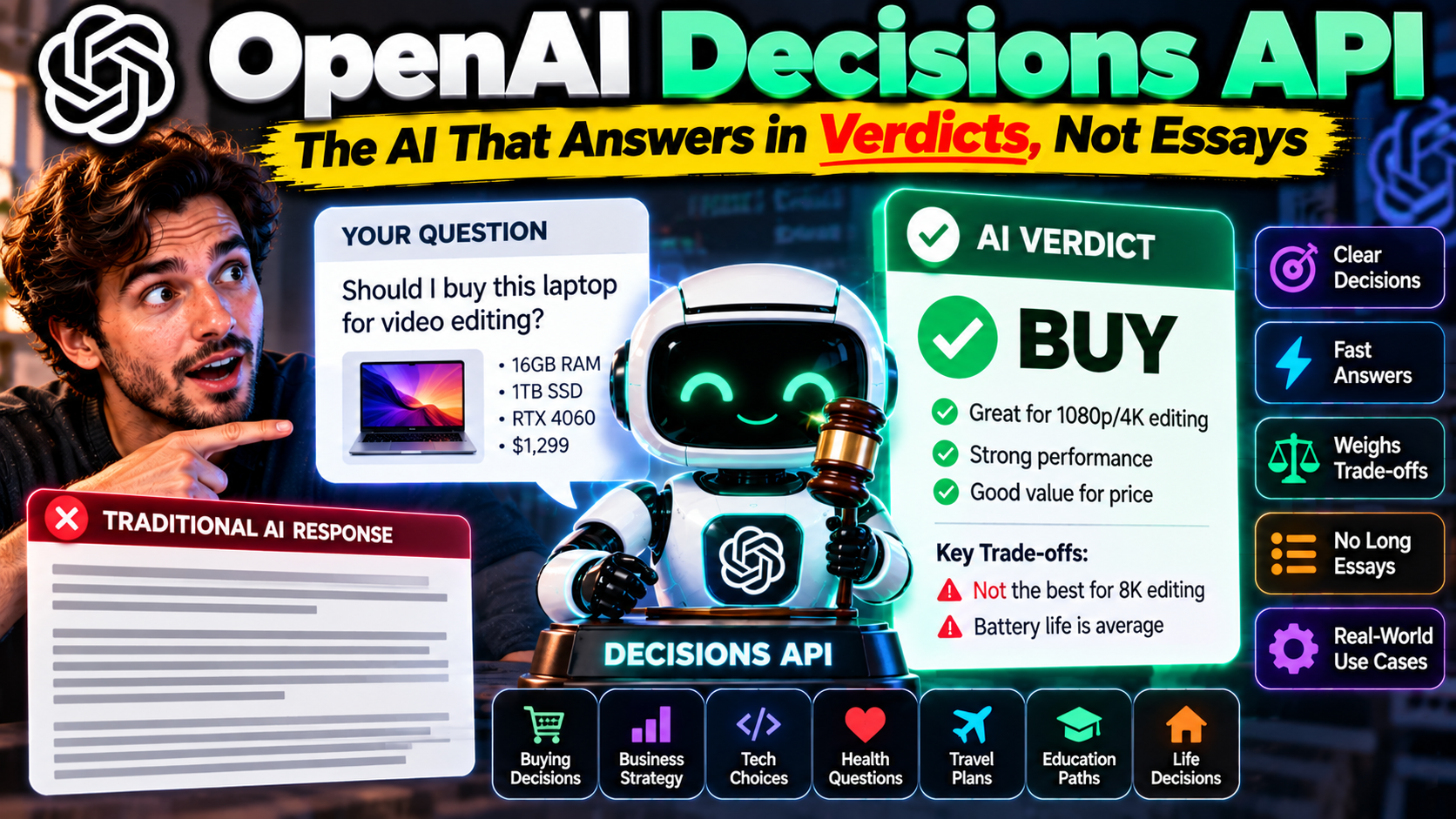
What if you could ask an AI a question and get back an answer your code can actually use — no paragraph to parse, no polite fluff to strip out? That’s the bet behind the OpenAI Decisions API, which entered public beta on October 6, 2026. It doesn’t write. It decides.
What the Decisions API Actually Is
It’s a single endpoint — POST /v1/decisions — that turns text or images into a machine-usable answer. You send evidence plus a question. You get back one of three typed shapes:
- Predicate: a probability from 0 to 1 that a condition is true. (“Is this message urgent?”)
- Choice: one option picked from your fixed list, with confidence scoring. (“Route to: billing, support, shipping, or account.”)
- Score: a rating against severity levels you define.
Right now there’s exactly one model behind it: gpt-6-luna. Inputs can be text, images, or both — though images have to arrive as inline base64 data URLs, up to 128 per request. Hosted links and uploaded file IDs get refused. For the full technical breakdown, the DEV Community walkthrough goes deep on requests, routing, and limits.
Why Developers Should Care
Here’s the familiar pain this kills. Today, if your app needs a true/false or a category label from AI, you prompt a chat model, get back a paragraph, and then regex the answer out of the prose. It’s fragile. It breaks. Everyone hates it.
Decisions skips all of that. The answer arrives already structured — your code branches on it directly. OpenAI says it runs about 10 times faster than its Responses API for this kind of work. Treat that as OpenAI’s claim, not a measured fact, until independent benchmarks land. Still, the pricing is genuinely interesting: $0.10 per million input tokens, and $0 for output. You read that right — output tokens are free, because there barely are any.
Think about what that unlocks for real products: spam triage, support-ticket routing, content moderation queues, quality scoring on assembly lines. Anywhere a human currently eyeballs something and picks a bucket, this API wants the job. Our AI coding tools roundup covers more of the developer-side AI wave, and the AI tools section has the broader picture.
The Honest Caveats
It’s a beta. So let’s be real about the rough edges:
- One model only. If
gpt-6-lunamisjudges your domain, there’s no alternative to switch to yet. - The 10x speed claim is unverified. One independent tester clocked a median 0.20s per decision on image classification — fast, but your mileage will vary.
- Probabilities aren’t truth. That same test found a clean egg scored 47% “dirty” vs 44% “clean” — basically a coin toss. Set confidence thresholds and route the uncertain cases to a human.
- General availability is “in the coming weeks.” That’s OpenAI’s expectation, not a date.
Who It’s For (and Who Should Skip)
Building anything that classifies, routes, or scores at volume? This deserves a look — the free playground alone is worth an afternoon of experiments. Just writing a chatbot or generating content? This isn’t for you; it literally cannot write a paragraph.
The bigger picture: OpenAI isn’t alone here. TypeSafe’s Jev does something similar at $0.042 per million input tokens. The “decision model” category is forming fast, and this beta is OpenAI planting its flag. Whether developers switch will come down to measured accuracy and latency, not launch-day claims. Smart money says: prototype now, commit later.
Related Reading
Keep exploring: AI Coding Tools That Make You Faster in 2026, Best Free AI Tools in 2026 (No Card Required), and ChatGPT vs Claude vs Gemini: Which AI Should You Actually Pay For?.