Google’s Gemini Agent Wants to Run Your Entire Workday
Google just made its biggest workplace AI bet yet.
On October 8th, at the Gemini at Work 2026 event, Google Cloud CEO Thomas Kurian unveiled the Gemini agent — a universal AI assistant designed to handle your entire workflow. Not just chat. Not just search. Everything.
What It Does
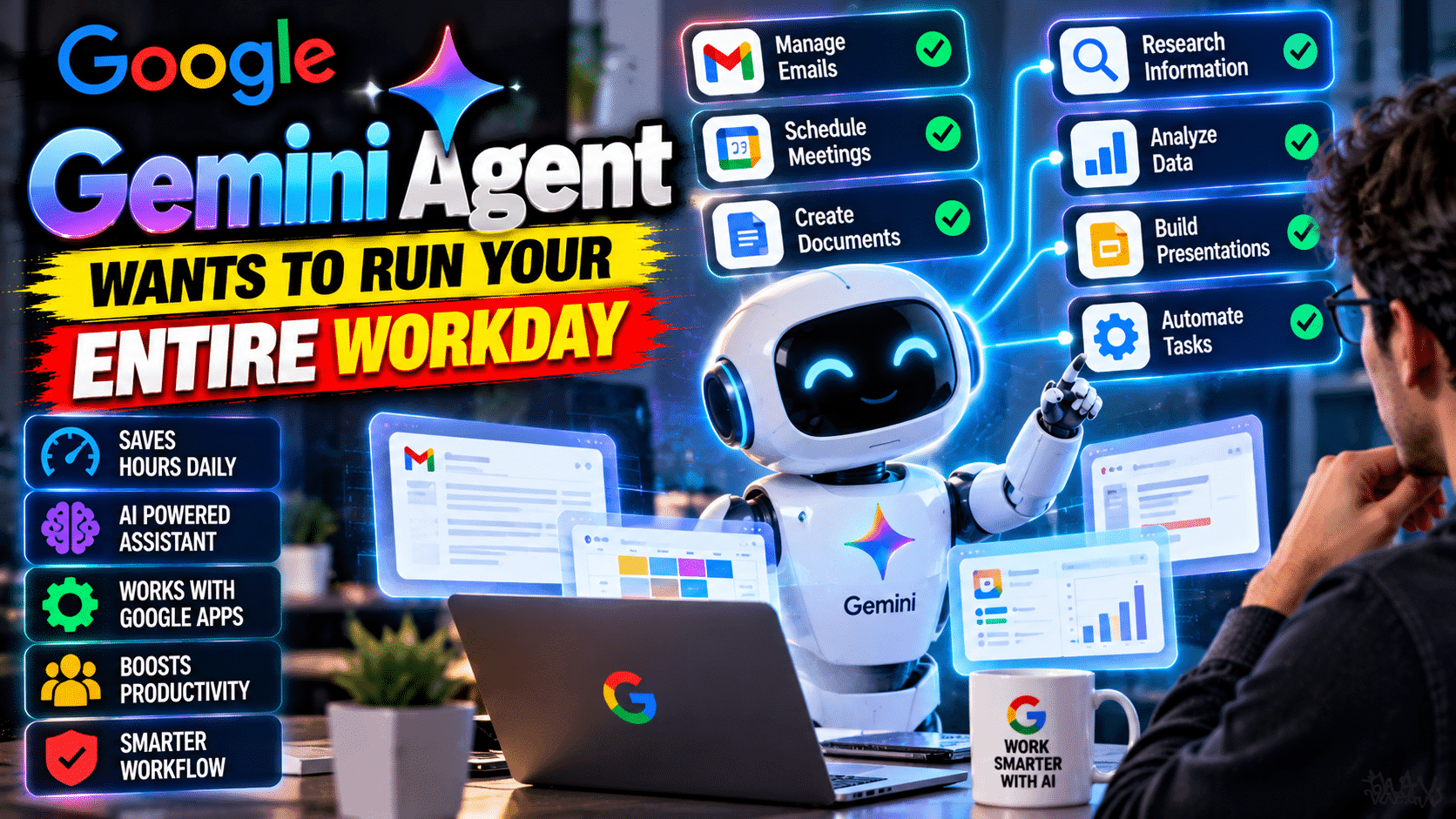
The Gemini agent is positioned as a persistent workplace companion. It answers questions across your work apps, handles multi-step tasks autonomously, creates content (docs, presentations, code), writes and reviews code, and manages knowledge work across Gmail, Docs, Sheets, and Workspace.
The key word is persistent. It keeps running in the cloud even after you close your laptop. You assign it a task, walk away, come back to results.
How It Works
Each job gets routed to the best-fit model. Simple questions go to fast, cheap models. Complex reasoning goes to the heavy hitters. You don’t choose — the system decides.
It also has persistent memory and multi-agent orchestration. Translation: it remembers context across sessions, and it can spin up sub-agents to handle parts of a complex task in parallel.
The Competition
This is a direct answer to OpenAI’s always-on agents. The “agent war” has moved from chat windows to entire workflows.
Microsoft has Copilot deeply integrated into Office. Anthropic has Claude for enterprise coding and analysis. Now Google’s bringing the full weight of Workspace integration.
The differentiator? Google owns the apps where work actually happens — Gmail, Docs, Sheets, Drive, Calendar. If the Gemini agent works as advertised, it lives where your work already lives. No context-switching.
What It Means for You
If you use Google Workspace, this is worth watching. The promise is less busywork — fewer manual data transfers between apps, fewer repetitive reports, fewer “let me just look that up” interruptions.
The reality? We’ll see. Enterprise AI agents have a habit of overpromising in demos and underdelivering in production. The persistent memory and multi-agent features are genuinely interesting, but they need to work reliably at scale.
Still, the direction is clear. AI isn’t a chatbot you visit anymore. It’s becoming infrastructure — always on, always working, woven into the tools you already use.
Google’s just made its move. Your move, Microsoft.