Gemini 4 Argon Is Now in the Gemini App: What Android Users Actually Get
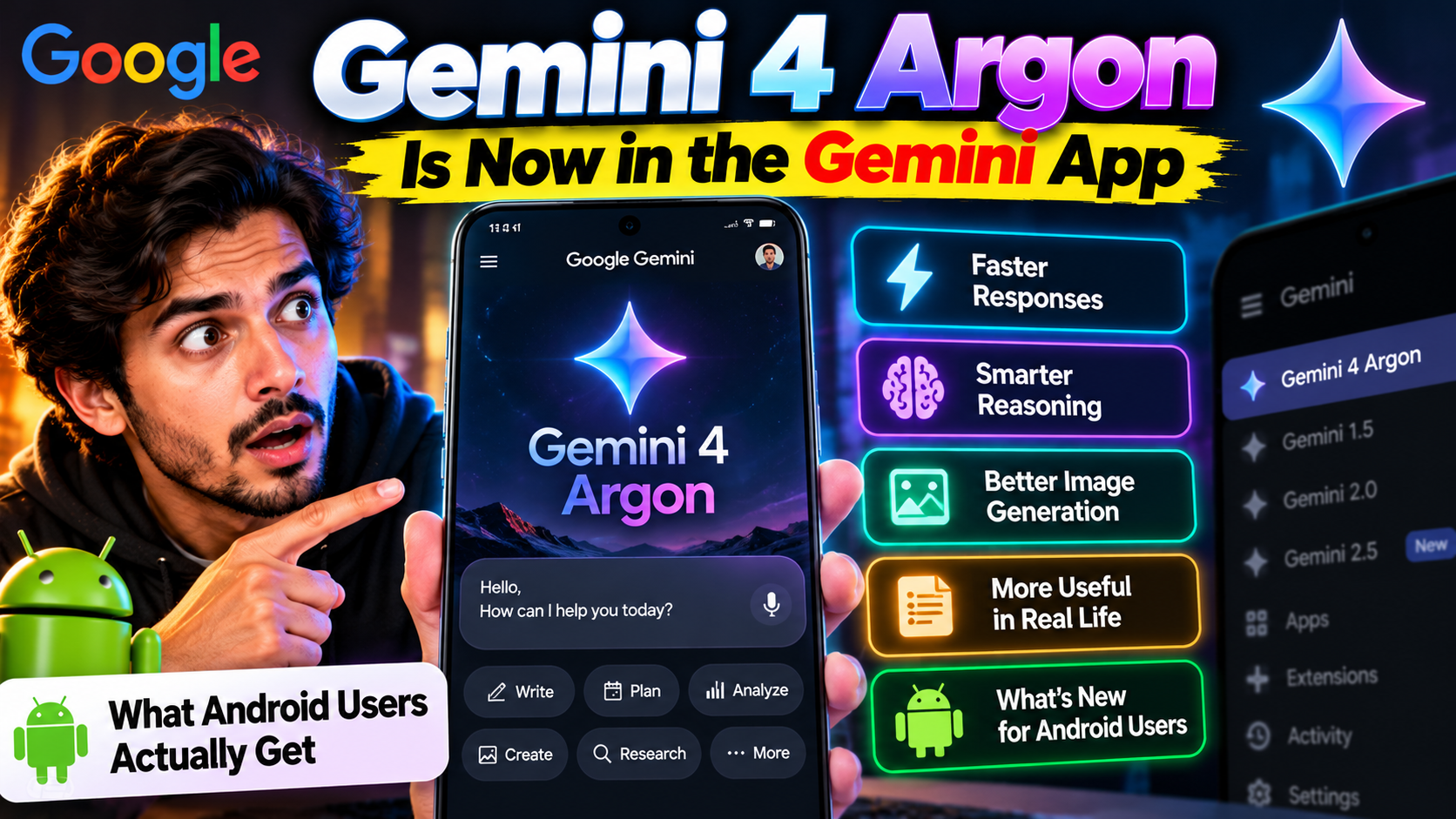
Google’s most powerful AI model to date is now inside the app on your phone — if you pay for it. Gemini 4 Argon, announced on 30 September 2026, became generally available on 13 October, and the Gemini app on Android is one of the places you can use it. But who gets it, what does it actually do better, and is it worth a subscription? Here is the straight version.
What Argon is built for
Argon is not a small upgrade to the everyday Gemini you already know. Google built it for deep, multi-step work: untangling large codebases, working through finance and legal documents, cybersecurity research, and science problems that take many steps to solve. It has a 1-million-token unified input-output limit, which means it can hold very long documents and conversations in mind at once, and Google says it works longer on hard problems instead of giving up early.
Google also claims Argon ranks first on the Vals Index, a benchmark covering coding, finance, legal, and tax work, and points to its own engineers using it to reorganise parts of the Chromium browser codebase. Those are Google’s own numbers and stories, and independent tests were still to come at the time of writing. Treat the claims as a direction, not a verdict.
Who gets it in the Gemini app
Argon in the Gemini app is for paying subscribers only:
- Google AI Pro (about $20 a month): Argon in the Gemini app and in AI Mode in Search.
- Google AI Ultra (about $100 a month): everything Pro gets, plus Argon in AI Studio and in Antigravity, Google’s agent-first coding platform.
- Free users: no Argon. The model is not on the free tier of the app or the API.
Google said the rollout would spread over several days after 13 October, so if you subscribe and do not see it yet, it may simply be your turn not having arrived. Note one confusing detail: Google’s pricing page says Argon is not available on the Pro plan, but that refers to API and AI Studio access — Pro subscribers do get it inside the Gemini app and AI Mode. Antigravity stays Ultra-only.
The price that doubles
For developers using the API, the intro price is $2 per million input tokens and $10 per million output tokens, with cached input 95% off. That intro rate runs only through 30 November 2026. After that, the standard price is $4 input and $20 output. If you are building something on Argon, plan your budget around the December price, not the intro price.
For app users, the cost is simpler: your Pro or Ultra subscription covers it, with no per-token bill. That makes the app the cheapest way to try Argon, as long as you already pay for a plan or were considering one.
What to try first in the app
Argon shines on jobs where a normal chatbot gives up halfway. Good first tests:
- Drop in a long document — a contract, a research paper, a 50-page report — and ask it to pull out the key terms, risks, or contradictions.
- Ask it to explain a piece of code and then improve it, in the same conversation, so it keeps the full context.
- Give it a multi-step research question that needs several sources checked against each other, and ask it to show its working.
For quick questions — “what is the weather”, “write a birthday message” — Argon is overkill. The standard Gemini model handles those faster and cheaper. Use Argon where depth matters, and you will notice the difference. Use it for everything, and you will mostly notice the subscription bill.
Argon also appears in AI Mode inside Google Search for Pro and Ultra subscribers, which is worth trying for research questions where you want a deeper answer than a normal search summary. Ask something that needs several sources weighed against each other, and you should see the same longer-working style that defines Argon in the app.
The honest caveats
Three things to keep in mind before you upgrade just for Argon. First, the benchmark headlines come from Google, and outside testers had already begun noting that headline scores can reflect a high-effort mode rather than the default experience. Second, Argon was first given to a small group of cybersecurity professionals under Google’s Fairwind Program, with fewer guardrails for vulnerability research — the version in your app is the standard consumer version, not that one. Third, Google has not said when, or if, free users will get Argon at all.
So should you pay for it? If you already subscribe to Pro or Ultra, open the Gemini app and try Argon on a real, hard task this week — it costs you nothing extra. If you do not subscribe, ask whether you regularly hit the limits of the free model on long, complex work. If the answer is yes, the Pro plan is the sensible entry point. If the answer is no, Argon is exciting news for the industry, but not a reason to change your plan today.