
OnePlus 16 vs REDMAGIC 12 Pro+: Same Flagship Chip, Two Very Different Ideas
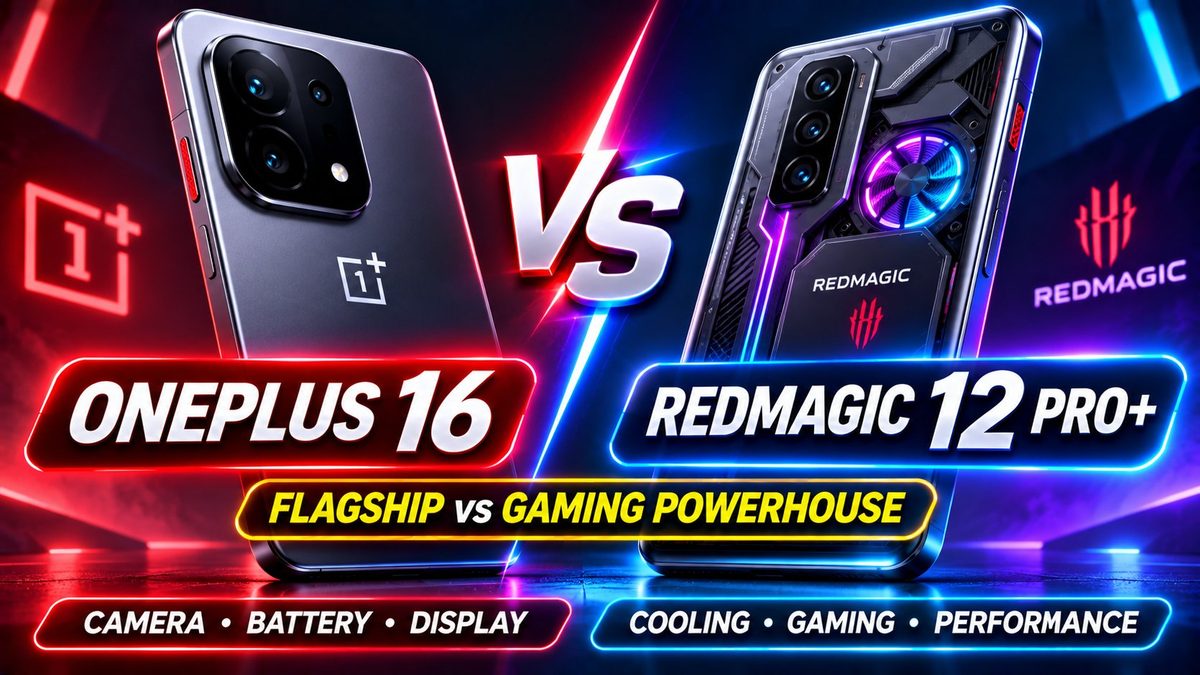
Two phones launched in China days apart this October, both running Qualcomm’s brand-new Snapdragon 8 Elite Extreme Gen 6 — and they could hardly be more different. The OnePlus 16, launched 12 October, is a mainstream flagship with a giant battery and a serious camera. The REDMAGIC 12 Pro+, launched 15 October, is a gaming machine first and a phone second, with a fan you can see and a screen with no hole for a selfie camera at all.
One honest note before we start: neither phone has been independently tested outside China yet, and we have not handled either one. This comparison is built on confirmed launch specs and prices, not hands-on impressions. Think of it as a spec-sheet showdown with context, not a final verdict.
Design and display: clean vs unapologetic
The OnePlus 16 keeps things restrained. A 6.78-inch LTPO OLED at 2772×1272, 165Hz for everyday use with 185Hz available in supported games, 1.15mm bezels, and an ultrasonic fingerprint scanner under the screen. It looks like a normal premium phone, which is the point — it has to work in a meeting as well as in a game.
The REDMAGIC 12 Pro+ goes the other way. A 6.85-inch 1.5K OLED at 185Hz with a 9th-generation under-display selfie camera, so nothing interrupts the screen at all, and bezels of just 0.96mm. The back is transparent in places, showing off the cooling system with RGB lighting. It is not subtle, and it is not trying to be. If you game for hours, an uninterrupted screen and shoulder triggers matter more than looking understated.
Performance and cooling: shared chip, different support acts
Both phones run the Snapdragon 8 Elite Extreme Gen 6, a 2nm chip with prime cores up to 5.0GHz. On raw speed, they should be close — the chip is the same, and both pair it with up to 16GB of RAM and up to 1TB of storage.
The difference is what sits around the chip. REDMAGIC adds its own RedCore R5 gaming chip and the AquaCore 3.0 cooling system: a dual-loop liquid setup with a visible fan (up to 25,500rpm in reports) and liquid metal, built to hold peak performance during long sessions. OnePlus relies on a vapour chamber and dedicated chips for touch, Wi-Fi, and display rendering to cut latency. For short bursts, both will feel fast. For a two-hour gaming session, REDMAGIC’s cooling is designed for exactly that job, and that is where it should pull ahead.
Battery and charging: both huge, one faster
Here the OnePlus wins on size and the REDMAGIC wins on speed:
- OnePlus 16: 9,000mAh, 100W wired, 50W wireless.
- REDMAGIC 12 Pro+: 8,400mAh typical capacity, 120W wired, 80W wireless, plus bypass charging that feeds power straight to the board during gaming so the battery stays cooler.
Both are far beyond the 5,000mAh norm of recent flagships, and both should comfortably last a heavy day. Note that the REDMAGIC’s official European listing shows an 8,150mAh rated capacity — that is the same battery measured under a different standard, not a smaller cell, and the 8,400mAh typical figure is the one to compare.
Cameras: not really a contest
If photos matter to you, this section decides the comparison. The OnePlus 16 has a 200-megapixel main camera (1/1.4-inch, f/1.6), a 50-megapixel 3x periscope telephoto, a 50-megapixel ultrawide, and a 50-megapixel selfie camera. The REDMAGIC 12 Pro+ has 50-megapixel rear cameras and an under-display selfie camera, which historically trades some selfie quality for a clean screen.
OnePlus is clearly the camera phone here. REDMAGIC’s cameras are good enough for everyday shots, but nobody buys a REDMAGIC for its camera system — they buy it despite the camera system, because of everything else.
Price and availability
China prices:
- OnePlus 16: CNY 5,999 (about $896) for 12GB + 256GB, up to CNY 8,499 (about $1,270) for 16GB + 1TB.
- REDMAGIC 12 Pro+: RMB 6,999 (about $1,047) for 12GB + 256GB, RMB 7,999 for 16GB + 512GB, and RMB 8,999 for 16GB + 1TB. Colours are Nightfreeze, Subzero, and Skyfrost.
Availability is where the two paths split. The OnePlus 16 is China-only for now, with no US or European release planned according to pre-launch reporting and India unconfirmed. The REDMAGIC, by contrast, will launch globally as the REDMAGIC 12 Pro on 3 November 2026 at 7 AM EST, with global pricing and configurations announced then. So if you live outside China and want one of these two phones soon, the REDMAGIC is the one you can actually buy — at least, once its global prices are revealed.
Which one fits whom?
Pick the OnePlus 16 if you want a phone that does everything well: the biggest battery in a mainstream flagship, a strong camera system, and a clean design — and you can wait for, or live with, China-only availability for now.
Pick the REDMAGIC 12 Pro+ if gaming is the main job: the uninterrupted 185Hz screen, the visible liquid cooling, shoulder triggers, and bypass charging are built for long sessions, and the global launch on 3 November makes it the reachable option.
For everyone else, the real winner here might be the chip itself. Two very different phones on the same platform, both with batteries over 8,000mAh, show where Android flagships are heading: bigger cells, faster screens, and purpose-built cooling. Whichever of these two you prefer, the next wave of flagships will look more like them than like last year’s phones.