
ByteDance Releases Seedream 5.5 — Edit the Same Image 100 Times With Transparent Backgrounds
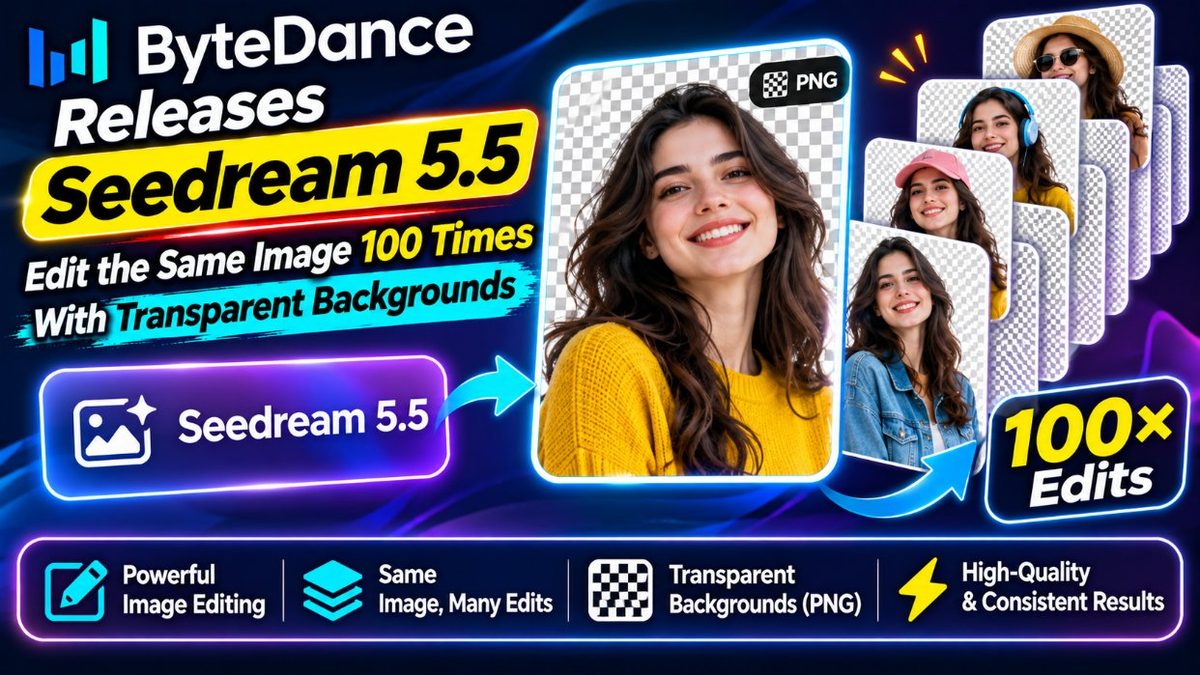
ByteDance Seed has released Seedream 5.5, its next-generation image creation model, and the headline feature is one working professionals have been asking for: you can now keep editing the same image, round after round, without it falling apart. The model supports stable editing across up to 100 rounds on a single image, ships with native transparent RGBA output, and renders small text more reliably than its predecessors.
The release landed on November 9, 2026, and it is aimed squarely at professional visual production — posters, product shots, marketing graphics, and the kind of layered design work where an image goes through dozens of revisions before anyone calls it done. So does it actually hold up under that kind of use? Here is what we know so far.
100 rounds on the same image
Most image editors have a familiar weakness: every edit costs you a little quality. Change the background, fix a detail, adjust the lighting, and by the tenth revision the image starts to drift — faces shift, colours muddy, small details blur into something else. That drift is why serious design work still leans on manual tools for the final passes.
Seedream 5.5 is built to push back on that problem. According to ByteDance Seed, the model keeps an image stable across up to 100 editing rounds, so a designer can iterate on the same file again and again without the subject quietly changing shape. A hundred rounds is a lot — far more than a typical poster or product image needs — but the point is the headroom. If the model stays consistent through a long edit session, short ones are easy.
That matters because real design work is rarely one prompt and done. A client asks for a different background, then a new headline, then a colour tweak, then the original background back. Each of those steps is another round, and each one used to be a small gamble. A model that survives the full chain changes how a team can work with it.
Transparent backgrounds, built in
The second headline feature is native transparent RGBA output. In plain terms, Seedream 5.5 can produce images with a genuinely transparent background, rather than a white or coloured one you have to cut out afterwards.
Anyone who has made a product listing, a logo lockup, or a social media graphic knows why that matters. Cutting out a background by hand is slow, fiddly work, and automatic background removers often chew up fine edges — hair, thin straps, glass, anything with soft detail. Getting transparency straight out of the model skips that whole step, and the result drops cleanly onto any layout.
It also fits the way ByteDance is positioning the model. This is not pitched as a toy for one-off fun images. It is pitched as a production tool, and transparent output is the kind of unglamorous feature that production teams actually care about — the sort of thing that saves an hour on every asset, multiplied across a whole campaign.
Small text, fewer mistakes
The third improvement is small-text rendering. Image models have long struggled with text, and small text most of all: letters warp, words duplicate, and a clean headline turns into gibberish at poster size. Seedream 5.5 improves on that, and ByteDance reports a severe text-corruption rate of just 0.4 percent.
That figure needs a note of caution, which we will get to below. But if it holds up in real use, it opens a door that has stayed half-shut for image models: graphics that carry real words. Posters, packaging, thumbnails, and ad creatives all need text that reads correctly, and a model that garbles one word in every few images is a model a designer cannot trust with a deadline.
Where you can try it
Seedream 5.5 is rolling out across ByteDance’s own surfaces: Dreamina (known as Jimeng in China), CapCut, Doubao, BytePlus, and Volcengine Ark. That spread covers casual creators on Dreamina and CapCut, everyday users on Doubao, and developers and businesses through BytePlus and Volcengine Ark.
Pricing sits at around 0.28 RMB per 2K edit, and a Pro version is on the way — though ByteDance has not shared its price or release date yet. For now, the standard version is the one rolling out, and the Pro tier looks like a later step for heavier professional use.
You can read more about the model family on ByteDance Seed’s official models page, which lists Seedream 5.5 among its current image models.
The numbers come with a caveat
Here is the honest part. The benchmark results behind this launch — including the text-corruption figure and the model’s standing on MagicArena — are ByteDance’s own claims. They have not been independently verified, and the company has every reason to present its model in the best light. That does not make the numbers false, but it does mean they should be read as the vendor’s case, not as settled fact.
This is a familiar pattern in AI right now. Every lab launches with strong numbers, and the real test comes when ordinary users push the model in ways the launch demos never showed. The 100-round editing claim, the transparency quality, the small-text accuracy — all of them will be judged by designers trying real briefs, not by a benchmark table.
The industry knows this, too. The same week has seen AI companies under pressure to prove their systems work as claimed — OpenAI even brought in outside attackers to stress-test its own models and raised its bug bounties to $172,000. Claims are cheap; evidence is what counts, and Seedream 5.5 will earn its reputation one edit at a time.
What it means for creators
If the headline features hold up, Seedream 5.5 lands in a crowded week for creative AI. Google’s Gemini Omni 1.2 Flash just made 15-second AI video cheaper and faster, and ByteDance is now answering on the image side with a model built for long, careful editing rather than quick one-shot generations.
For a working designer, the pitch is simple: fewer do-overs, cleaner cutouts, and text you can trust. The 100-round limit is the most interesting promise of the three, because it targets the exact place where image models usually break down — the tenth edit, not the first. A model that survives a full revision cycle is a model a studio can build a workflow around.
Whether Seedream 5.5 delivers on that promise is something the next few weeks will show, as it reaches more users through Dreamina, CapCut, and the rest of ByteDance’s platforms. The launch is real, the features are clear, and the price of an edit is low enough to try. What remains is the only test that matters: does it still look good on round ninety-nine?