
FCC Clears SpaceX to Launch One Million Starmind Orbital Data Center Satellites
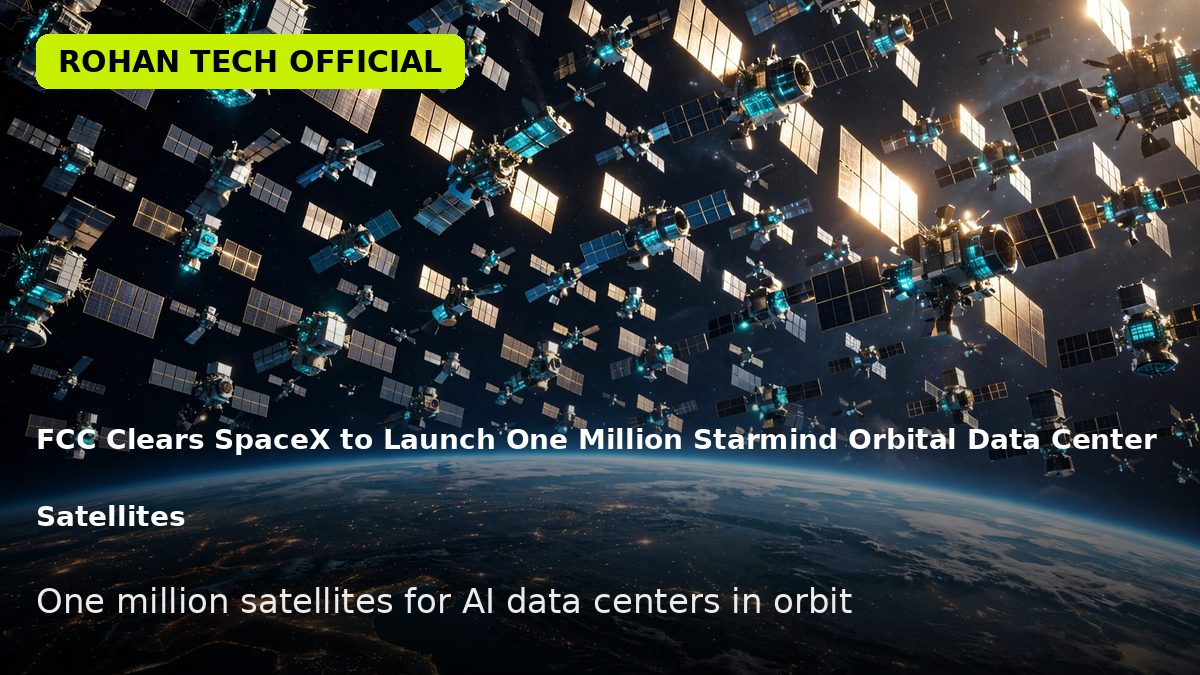
The Federal Communications Commission has cleared SpaceX to launch up to one million satellites that will work as data centers in orbit. The approval, announced on Tuesday, November 25, covers the company’s Starmind constellation — the first time a regulator anywhere has authorised a network of orbital data centers at this scale.
It is a striking idea: instead of building ever-larger data centers on the ground, put the computers in space, where sunlight is constant and cooling is free. The FCC called the decision a historic first. Whether the network ever gets built at anything close to this size is a different question.
What the approval actually covers
The FCC’s order (DA 26-1273) authorises SpaceX to deploy and operate up to 1,000,000 orbital compute modules in shells between 500 and 1,002 kilometres above Earth. The satellites would be optically linked to each other and process data for use back on Earth, mainly for AI workloads.
The authorisation comes with hard deadlines. SpaceX must put one satellite in orbit by November 25, 2033, reach 10% of the constellation by 2035, half by 2038, and the full million by 2040 — or the authorisation lapses. The approval runs for 15 years from the first launch.
There are conditions attached. SpaceX must file a final plan for limiting space debris before it deploys any satellite above 600 kilometres, and the FCC wants communications backups, regular progress updates and a detailed debris-mitigation plan. The FCC also deferred a decision on SpaceX’s request to waive the rule requiring dead satellites to burn up in the atmosphere, saying the company had not provided enough information to judge its alternative disposal methods.
SpaceX first revealed its orbital data center plans in January. The company says each Starmind satellite would carry a compute payload averaging 175 kW and peaking at 250 kW, with the first computing satellite built around NVIDIA’s Vera Rubin NVL72 system. President and COO Gwynne Shotwell told investors in October that SpaceX plans to start launching Starmind satellites in 2027, and an IPO filing describes a deployment rate of 100 gigawatts of orbital compute per year.
Why orbit, and who objected
The pitch is simple: space offers endless solar power and no land, water or grid constraints, at a moment when AI data centers on Earth are straining power supplies. The FCC framed the approval as a way to extend American leadership in super-intelligence, and Chair Brendan Carr announced it on X as a historic first for the agency.
Not everyone is cheering. Amazon, Viasat and the American Astronomical Society filed petitions to deny the application, and groups including the Secure World Foundation asked for more scrutiny. Astronomers worry that a million bright satellites would make large parts of the sky unusable for ground-based telescopes, and the debris risk from a constellation this size is unlike anything regulators have dealt with before.
SpaceX is not the only company chasing the idea. Starcloud plans 88,000 satellites and 20 gigawatts of orbital compute, and filings from SpaceX, Starcloud, Blue Origin and Cowboy Space together ask for up to 1,159,600 satellites. The FCC said it is still reviewing the other orbital data center proposals and will decide on each in turn — so far, only SpaceX has been approved.
What it does not mean
An FCC authorisation is not a working system. It licenses the radio links and sets the deadlines; the engineering challenge of building, launching and operating a million computing satellites — and doing it profitably — is still entirely ahead of SpaceX. The Register’s take was blunt: the approval is “a long way from the launchpad, or making sense.”
The timing is still telling. AI models keep getting bigger and hungrier for compute, and the open-weight releases keep coming — each one needs somewhere to run. If even a fraction of Starmind gets built, it would change where AI computing happens. For now, the real test is the first satellite, due in orbit within seven years. Read the GeekWire report and the Light Reading breakdown for the full terms and conditions.
Approval is not the same as a working network
An authorisation from the regulator is not a working system. It licenses the radio links and sets the deadlines.
The scale is hard to picture. Up to one million orbital compute modules, in shells between 500 and 1,002 kilometres above Earth, optically linked to each other and processing data for use back on Earth, mainly for AI workloads. Each satellite would carry a compute payload averaging 175 kW and peaking at 250 kW, with the first computing satellite built around a named NVIDIA system.
The objections that will shape what happens next
Not everyone is cheering. Amazon, Viasat, and the American Astronomical Society filed petitions to deny the application, and groups including the Secure World Foundation asked for more scrutiny. Sky watchers worry that a million bright satellites would make large parts of the sky unusable for ground-based telescopes, and the debris risk from a constellation this size is unlike anything regulators have dealt with before.
The regulator attached conditions. The company must file a final plan for limiting space debris before it deploys any satellite above 600 kilometres, and the regulator wants communications backups, regular progress updates, and a detailed debris-mitigation plan. It also deferred a decision on the request to waive the rule requiring dead satellites to burn up in the atmosphere, saying the company had not provided enough information to judge its alternative disposal methods.
Milestones worth watching over the next few years
The authorisation comes with hard deadlines, and they give readers a simple way to track progress. The company must put one satellite in orbit by November 25, 2033, reach 10 percent of the constellation by 2035, half by 2038, and the full million by 2040, or the authorisation lapses. The licence stays valid for a decade and a half, counted from the day the first satellite goes up.
The company is not the only one chasing the idea. Another firm plans 88,000 satellites and 20 gigawatts of orbital compute, and filings from four companies together ask for up to 1,159,600 satellites. The regulator said it is still reviewing the other proposals and will decide on each in turn, and so far only one company has been approved.