
The UK Wants to Ban Under-16s From Social Media: Inside the Biggest Platform Fight Yet
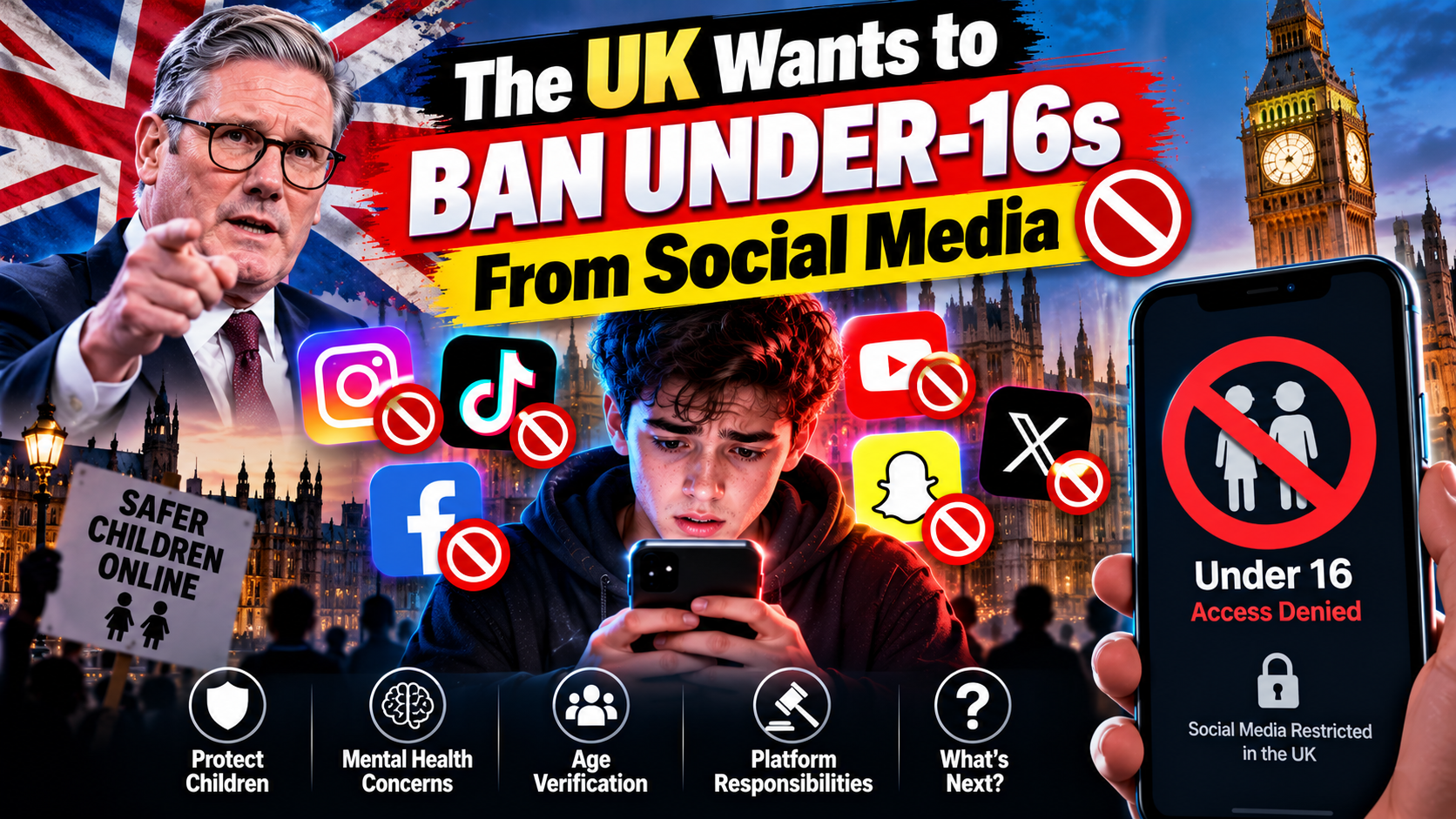
The fight over kids and social media just escalated — dramatically. The UK government announced plans to ban under-16s from TikTok, Instagram, Snapchat, Facebook, X, and YouTube, following Australia’s lead. Meanwhile Meta, TikTok, and X launched one of the first legal challenges against the UK’s online safety regulator. And on top of all that, Meta’s $17 billion teen-safety settlement in the US is heading toward a major trial later this month. This is the biggest confrontation between governments and social platforms in history, and the outcome will shape the internet for a generation.
The UK Ban: What Was Announced
The UK plan would prohibit children under 16 from using TikTok, Instagram, Snapchat, Facebook, X, and YouTube, modeled on Australia’s pioneering legislation. Stronger age-verification requirements are part of the proposal — the technical crux that decides whether the ban works or becomes a paper tiger.
The public consultation pulled in over 116,000 responses, and the political signal is hard to miss: 9 in 10 parents back the ban. That’s remarkable consensus in a country that rarely agrees on anything. It reflects a real shift in public mood — the “maybe social media is harming our kids” conversation of five years ago has hardened into “we need to do something, now.”
But announcements aren’t laws. The proposal still has to survive parliament, industry lobbying, and the practical question of enforcement. Australia’s experience is instructive: its under-16 ban hit exactly the implementation problems skeptics predicted — VPNs, fake birthdays, platforms dragging their feet on verification. The UK will face all of it, at bigger scale.
The Age Verification Problem
Here’s the technical reality nobody in government likes dwelling on: reliably verifying a user’s age online without building a surveillance nightmare is genuinely hard. Every option is flawed. Self-declaration (type your birthday) is trivially bypassed — every teenager on the planet knows this. ID document checks work but create honeypots of sensitive identity documents and shut out kids without IDs. Biometric age estimation (face scanning) raises its own privacy alarms and has accuracy gaps across demographics. Third-party verification services add friction that kills signups.
Each approach trades one problem for another: effectiveness vs. privacy vs. practicality. The platforms, unsurprisingly, favor the weakest effective option; child-safety advocates demand the strongest; privacy groups warn about the verification infrastructure itself. Whoever designs the UK’s regime is really choosing which failure mode the country gets. There’s no version without trade-offs — only versions with different ones.
Meta, TikTok, and X Fight Back
On October 6, Meta, TikTok, and X launched a legal challenge against Ofcom — the UK regulator — over the volume of content-moderation data demanded under the Online Safety Act. One of the first direct legal challenges to the UK’s online safety regime, and it matters beyond the specific data dispute.
The platforms’ argument, boiled down: the data demands are disproportionate and intrusive. The regulator’s position: you can’t oversee what you can’t see. Both have a point — which is what makes this genuinely interesting rather than routine corporate pushback. Content moderation at billion-user scale is a black box, even to the companies running it in some respects, and regulators are demanding a look inside systems the platforms themselves only partly understand.
Watch this case. It’s the template. The EU’s Digital Services Act, Australia’s regime, proposed US rules — all face the same question: how much of the machine do platforms have to show the government? The Ofcom challenge will set precedents echoing across every jurisdiction wrestling with platform regulation.
Meta’s $17 Billion Settlement and the October Trial
Across the Atlantic, the stakes are financial as well as regulatory. On August 26, Meta settled claims brought by US state attorneys general for up to roughly $17 billion over ten years, plus court-ordered teen-safety defaults on Instagram and Facebook — default-setting changes for young users imposed by court order, not by Meta’s choice.
$17 billion is a staggering figure — among the largest consumer-protection settlements ever. But the consolidated personal-injury cases still go to trial on October 28, 2026. Those allege something graver than regulatory violations: that the platforms’ designs caused real harm to real children. Trials mean discovery, testimony, internal documents going public — exactly the scrutiny settlements are designed to avoid.
Meta’s playbook here is familiar: settle with governments, fight the injury claims. But every litigation round produces more internal evidence about what the companies knew and when — while public opinion, already running 9-in-10 against the platforms among parents, keeps hardening.
What the Research Actually Says
Amid the politics, the science deserves a hearing — because it’s more nuanced than either side admits. Research on social media and teen mental health is genuinely mixed: some studies find real correlations between heavy use and anxiety/depression in teens, particularly girls; others find small or null effects once you control for confounding factors. The strongest findings center on specific mechanisms — social comparison, cyberbullying, sleep displacement, addictive design patterns — rather than “social media” as one blob.
That nuance matters for policy. A ban treats all social media use as harmful; the research says the problem is certain uses, certain designs, and certain vulnerable users. Targeted rules against addictive design patterns (infinite scroll, algorithmic amplification, notification engineering) might do more good than an easily-circumvented age ban — but they’re harder to explain in a headline and harder to enforce. Politics favors the simple instrument, even when science favors the precise one.
What Happens Next
Several timelines are converging now. The UK ban proposal moves from consultation toward legislation. The Ofcom legal challenge plays out in court. The US personal-injury trial starts October 28. Australia’s ban keeps serving as the real-world experiment everyone watches.
For parents, the practical advice hasn’t changed: the law won’t raise your kids. Talk to them about what they’re seeing. Keep devices out of bedrooms at night — sleep displacement is the most solidly evidenced harm. Model healthy use yourself. Use the parental controls that already exist. Regulation moves in years; childhood moves in days.
For the industry, the direction is unmistakable: the self-regulation era is over. Bans, design mandates, litigation-driven settlements — governments are dictating terms now. Platforms that adapt early, with genuine safety by design instead of compliance theater, will navigate this better than the ones fighting every step. The next two years will decide what social media looks like for the generation growing up in it. For ongoing coverage, follow our Tech News section and practical guides in Tutorials.
Related Reading
Keep exploring: How to Deactivate or Delete Your Facebook Account, How to Use Instagram Reels to Grow in 2026, and How to Stop Spam Calls on Android and iPhone.