
The Foldable Phone War Just Went Mainstream: iPhone Duo, Vivo X Fold 6, and October’s Launch Storm
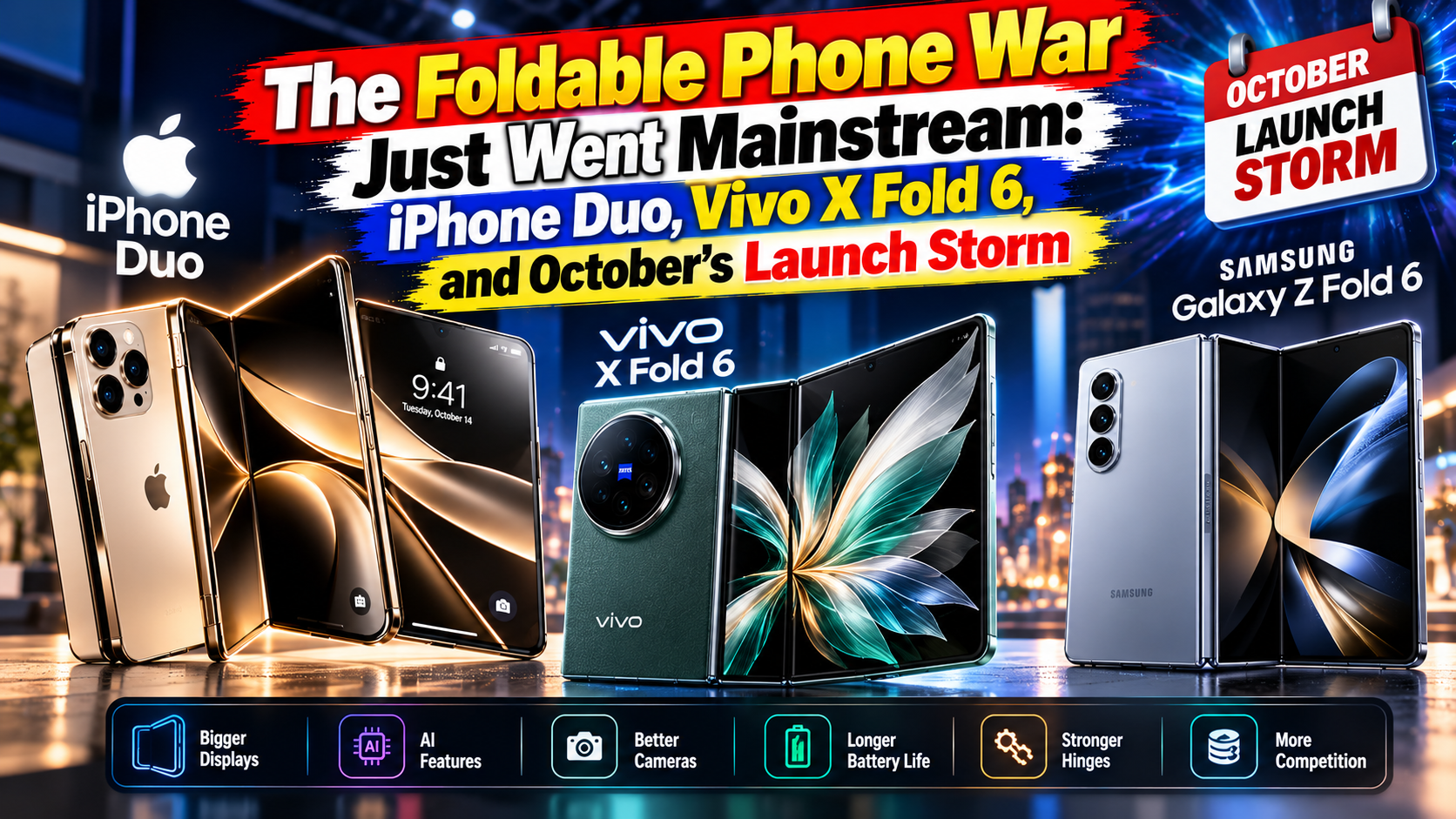
For years, foldable phones were the industry’s expensive experiment — impressive engineering that normal people admired from a safe distance. October 2026 is the month that changed everything. Apple just entered the foldable race with the iPhone Duo, Vivo answered with the X Fold 6, and the launch calendar is packed with new hardware from OnePlus and Oppo. For the first time ever, foldables aren’t a niche. They’re the main event.
Apple’s iPhone Duo: The Foldable That Matters Most
Start with the earthquake. On September 9, Apple launched its first-ever foldable phone, the iPhone Duo, priced at $1,999. Pre-orders open October 16, and it hits shelves October 23 in more than 70 countries. The specs read like classic Apple — arrive late, then try to define the category: an A20 Pro chip, a 5.4-inch cover display paired with a 7.6-inch 120Hz inner OLED, all running iOS 27.
So why does Apple’s entry matter more than every foldable before it? Because Apple doesn’t run public experiments. Samsung has refined foldables across seven generations; Huawei, Oppo, Vivo, and Honor have all shipped excellent folding phones. But none of them had Apple’s distribution, marketing muscle, and developer ecosystem. The moment Apple ships a foldable, app developers start caring about foldable layouts. Accessory makers start caring about foldable cases. Carriers start training staff to sell foldables. The whole industry’s center of gravity shifts.
It hasn’t been all smooth sailing. Reports suggest Apple nearly pushed the Duo to late November over production issues — the company scraped together enough inventory for October 23, but supply will be tight. Translation: want one at launch? Be ready on October 16 and don’t dawdle. Foldable displays are genuinely hard to build at scale, and Apple’s quality bar makes it harder still. Expect the familiar script — sold out in hours, shipping dates sliding into November, scalpers having a field day.
Vivo X Fold 6: The Android Answer
Apple’s timing didn’t go unanswered. On October 6, Vivo launched the X Fold 6 in India at ₹2,19,999 for the 12GB + 512GB configuration, with sales starting October 13. The spec sheet doesn’t mess around: an 8.02-inch inner display (bigger than the Duo’s), a 200MP Zeiss-branded camera system, and a huge 6,900mAh battery.
That battery number deserves a second look. Foldables have always had mediocre battery life — two screens drink power, and the folded form factor leaves less room for battery. The X Fold 6’s 6,900mAh cell, built on silicon-carbon battery tech, is a statement: the days of babying your foldable’s battery are ending. Real-world endurance is still to be seen, but on paper this is the first foldable you could take on a long travel day without a charger.
Then there’s the 200MP Zeiss camera — Vivo’s other flex. Foldables usually compromised on cameras versus slab flagships (the folding mechanism eats internal space). Vivo is signaling that compromise is over. Does a 200MP sensor actually take better photos than a well-tuned 50MP one? That’s a whole separate debate — megapixels are marketing as much as engineering — but the intent is clear: no more “good for a foldable” qualifiers.
October’s Full Launch Calendar
The Duo and X Fold 6 are the headliners, but October’s calendar is stacked. The OnePlus 16 launches in China on October 12, and the Oppo Find X10 series goes global on October 21. Four major launches in under three weeks — dense even by this industry’s standards.
One trend runs through all the Chinese flagships: batteries. Every Chinese Android flagship launching this month packs a 7,000mAh+ silicon-carbon battery. Sit with that for a second — 7,000mAh was unthinkable in a flagship two years ago; now it’s the baseline. Silicon-carbon chemistry is 2026’s quiet smartphone revolution: more energy density in the same space, bigger batteries without thicker phones. If your next phone lasts two days on a charge, thank chemistry, not software.
Are Foldables Finally Worth Buying?
The question everyone actually wants answered. My honest read, as of October 2026: for the first time, yes — with caveats. The hardware problems that plagued early foldables are mostly solved. The crease is minimal on current displays. Hinges are rated for hundreds of thousands of folds. Water resistance has arrived on recent models. Battery life, the last real weakness, is being fixed by silicon-carbon cells.
What remains? Price and software. $1,999 for the iPhone Duo isn’t a mass-market price — it’s early-adopter territory. Vivo’s ₹2,19,999 (around $2,600) is steeper still. These are luxury purchases for now, and they’ll stay that way until manufacturing scales further — which, ironically, Apple’s entry should speed up.
Software is the subtler problem. Android’s done solid work on foldable layouts, and iOS 27 brings Apple’s take. But the app ecosystem is still catching up — plenty of apps treat the big inner display as a stretched phone screen instead of a small tablet. That gets better every year and with every million foldables sold. We’re in the “good enough to buy, still improving fast” phase. Historically, that’s the best time to jump in if you love new tech — mature hardware today, software that keeps improving through updates.
What This Means for the Market
Here’s the strategic picture. Samsung owned the foldable market by default for years — the only serious player in most Western markets. Apple’s entry ends that free ride. Vivo, Oppo, and Honor have been strong in Asia. Now every major market has at least two credible foldable options, and competition is about to do what competition always does: push prices down and quality up.
My prediction: by late 2027, we’ll see the first genuinely mainstream-priced foldable from a major brand — something in the $999–$1,199 range that a normal upgrader cross-shops against a regular flagship. The $1,999 era is the top of the curve, not the permanent state. Intrigued but price-sensitive? Waiting 12–18 months is the smart play. Want the future right now? October 2026 just handed you the best options this category has ever had.
The slab phone had a 15-year run as the default. The next 15 might fold. For ongoing mobile coverage, follow our Tech News section and check essential Android apps to deck out your new device.
Related Reading
Keep exploring: Why Every Phone Brand Is Adding an AI Button in 2026, Tablet vs Laptop 2026: Which Should You Buy? An Honest Buying Guide, and USB-C Won the Charger War: What It Means for Your Next Phone.