Microsoft’s $5,999 AI Gamble: The Surface Laptop Ultra and the Race to Put AI on Your Desk
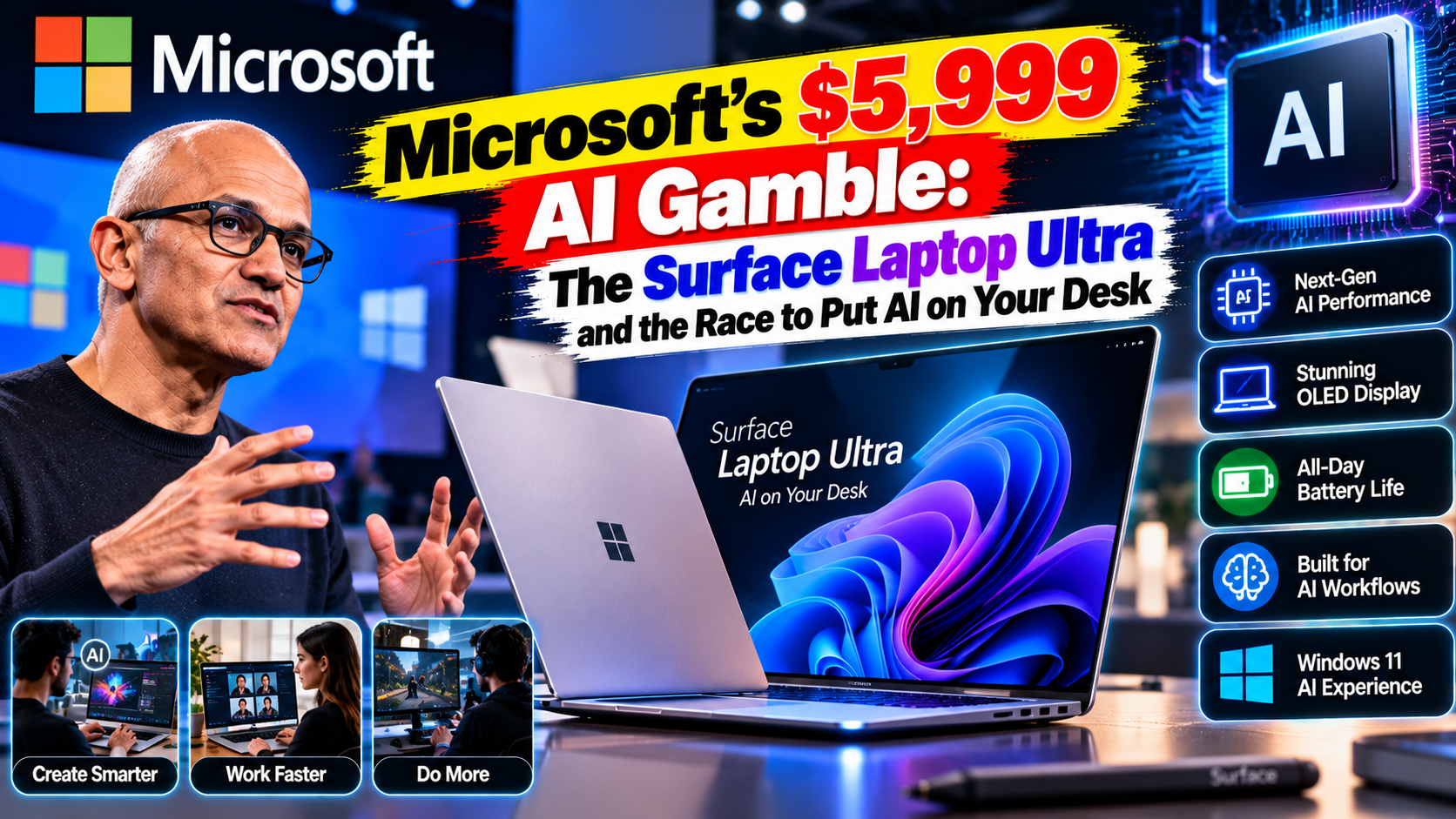
Microsoft just made its boldest hardware bet in years — standing next to Nvidia while doing it. At an October 7 event in San Francisco, the company unveiled the Surface Laptop Ultra powered by Nvidia’s RTX Spark, starting at $2,599 and shipping October 16 — plus a $5,999 RTX Spark Dev Box aimed at AI developers. Up to 128GB of unified memory, able to run 120-billion-parameter models locally. Microsoft isn’t just selling laptops anymore. It’s selling the AI workstation of the future.
The Hardware: RTX Spark Goes Mobile
The star of the show is Nvidia’s RTX Spark — serious AI compute in a laptop form factor. The Surface Laptop Ultra pairs it with up to 128GB of unified memory, and that’s the spec that actually matters for AI work. Large language models live or die by memory capacity, and 128GB is enough to run 120-billion-parameter models entirely on-device.
Why does on-device matter? Three reasons: privacy (your data never leaves the machine), latency (no round-trip to the cloud), and cost (no per-token API bills). For developers building AI apps, researchers experimenting with open models, and enterprises whose data can’t touch the cloud, local inference at this scale changes the game. Until now, running 120B-parameter models meant a rack of GPUs or a painful cloud bill. Microsoft and Nvidia just put it in a laptop.
$2,599 is steep for a laptop, but almost reasonable for what this is — a portable AI workstation. The $5,999 Dev Box is the desktop counterpart: more thermal headroom, more expansion, built for developers who need maximum local compute. Neither product is for casual users. That’s the point. Microsoft is selling picks and shovels for the AI gold rush.
Nadella and Huang, Together on Stage
The imagery mattered as much as the hardware. Microsoft CEO Satya Nadella and Nvidia CEO Jensen Huang shared a stage — a public display of one of tech’s most important partnerships. Microsoft is Nvidia’s biggest customer and closest cloud partner; Nvidia needs Microsoft’s enterprise distribution as much as Microsoft needs Nvidia’s chips.
There’s strategy under the photo op, too. Google has its TPUs. Amazon has Trainium. Meta is building its own inference chips. Microsoft’s answer: go all-in with Nvidia — the market leader — instead of reinventing silicon. It’s a bet that Nvidia’s ecosystem moat (CUDA, the developer tools, the sheer momentum) outweighs the savings of custom chips. Given Nvidia’s current dominance, it’s defensible — but it does leave Microsoft dependent on a single supplier in the most supply-constrained market in tech.
MXC: Sandboxing the AI Agents
The quieter announcement might be the more significant one: Microsoft Execution Containers (MXC) are now generally available. MXC sandboxes AI agents on Windows 11 — giving autonomous AI a contained environment to operate in, with controlled access to your system.
This is infrastructure for the agentic era, and it genuinely matters. AI agents that take actions — running code, modifying files, browsing the web — are powerful and dangerous in equal measure. Running them unsandboxed is asking for trouble. Running them in a proper container with defined permissions is how you get the benefits without the risk. Microsoft making this a built-in Windows 11 capability rather than a third-party add-on says agents aren’t an experiment anymore. They’re a platform feature now.
Alongside MXC, new Copilot agent features are rolling out through the Frontier program — Microsoft’s early-access channel for AI features. The Copilot strategy has come a long way from the “AI sidebar” days: it’s an agent platform now, with the assistant interface as just one surface. If you wrote Copilot off as a gimmick in 2024, it’s worth a second look in 2026. Different product entirely.
The Mainstream Surface Updates
Not everything was about $6,000 workstations. Microsoft also refreshed the mainstream lineup: the Surface Pro 12-inch and Surface Laptop 13-inch (2nd Edition) with Snapdragon X2 Plus chips and 80-TOPS NPUs, shipping October 13.
That 80-TOPS NPU number is the one to watch. TOPS (trillion operations per second) measures AI acceleration, and 80 is serious for thin-and-light machines — local AI features (background blur, live captions, on-device Copilot tasks, Recall-style search) run smoothly without draining the battery. The Snapdragon X2 Plus keeps the ARM-on-Windows story going: all-day battery, instant wake, and now real AI muscle.
The ARM transition on Windows has been the industry’s longest-running “this is the year” story — but 2026 might actually be it. App compatibility, the perennial killer, has improved dramatically through Prism emulation and native ARM ports from major developers. The remaining gaps are mostly niche pro tools and some games. For the mainstream buyer living in a browser, Office, and creative apps, ARM Windows is now a legitimate choice, not a compromise.
The Bigger Picture: The AI PC Wars
Microsoft’s event is one front in the industry-wide AI PC war. Apple has its M-series neural engines and Apple Intelligence. Google is pushing Chromebooks with on-device Gemini. Intel and AMD are cramming NPUs into everything. Qualcomm bet the company on ARM Windows. And now Microsoft-plus-Nvidia is pushing the high end with RTX Spark.
What’s actually at stake? The definition of what a computer is for. For forty years, PCs were tools you operated. The AI PC vision: computers that work alongside you — drafting, summarizing, coding, searching your own files, running agents while you do something else. The hardware (NPUs, unified memory, containers) is the foundation; the software (agents, on-device models, OS integration) is the building. Microsoft is constructing both at once — which is why this event felt bigger than a typical Surface refresh.
The open question: do regular consumers want this yet? Enterprise and developers are sold — the ROI on local AI compute is obvious. But the average laptop buyer? “80 TOPS” means nothing to them. What matters is whether the features feel magical or gimmicky. Microsoft’s 2027 challenge is turning silicon into experiences normal people can feel. Hardware’s ready. Software’s catching up. Marketing has work to do. For more Microsoft and PC coverage, see our Tech News and Windows tutorials.
Related Reading
Keep exploring: Tablet vs Laptop 2026: Which Should You Buy? An Honest Buying Guide, How to Make Your Old Laptop Feel New Again, and Windows 11 26H2 Is Here: What’s New and Should You Install It?.