
Internet From Space: Starlink, Amazon Leo, and the Satellite Broadband Race
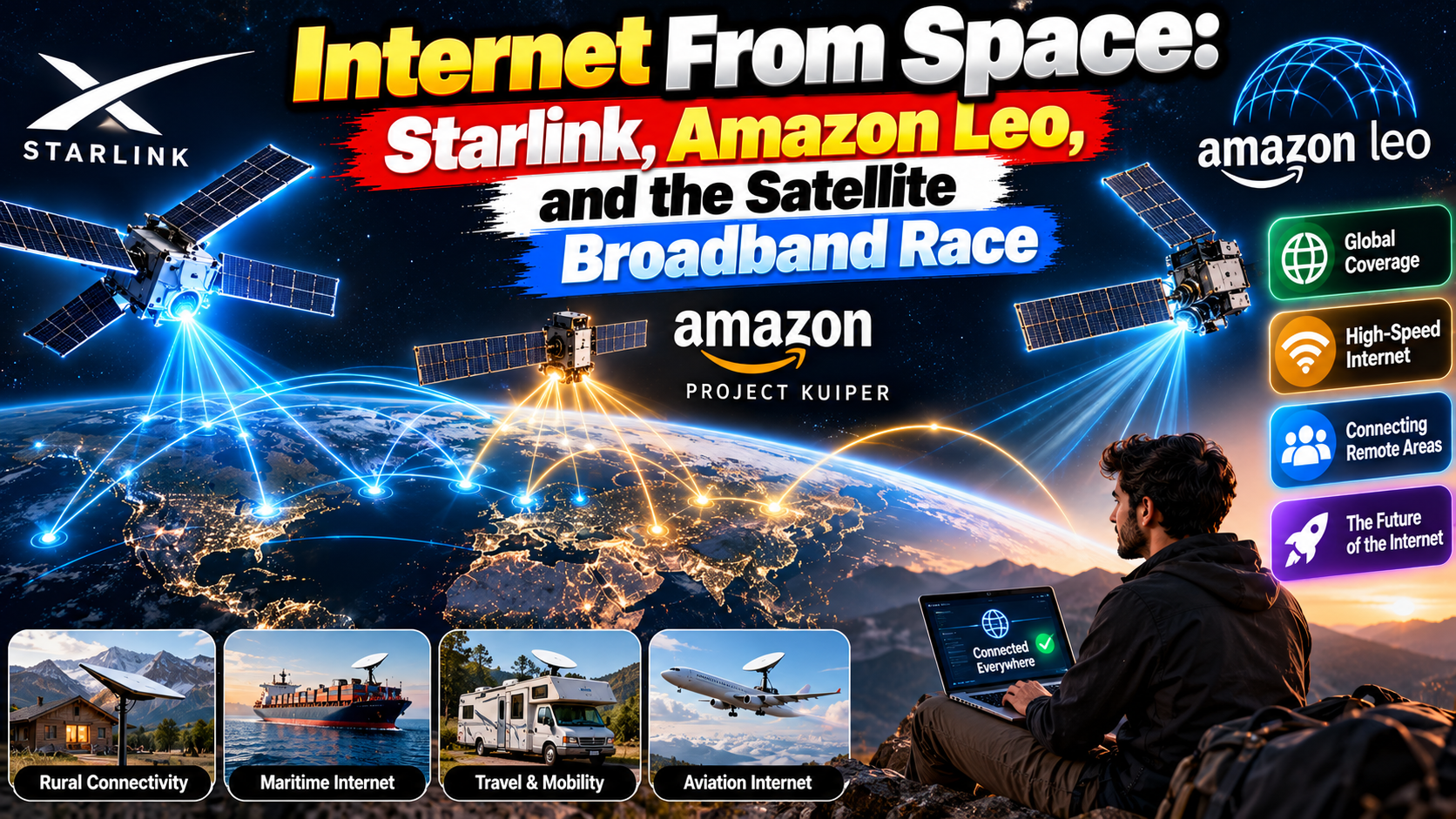
The internet is leaving the ground. In the past week alone, Starlink-powered satellite service launched for ordinary mobile phones in Bangladesh, Amazon revealed plans to bundle satellite broadband with Prime subscriptions, and India’s biggest telecom showed off its vision for 6G. The race to connect the planet from orbit is speeding up — and it’s about to change what “being online” means for billions of people.
Bangladesh: Satellite Internet on Your Regular Phone
On October 7, Banglalink launched Starlink-powered satellite-to-mobile service in Bangladesh — the first deployment of its kind in South Asia. The details matter: it works on ordinary 4G phones with a regular Banglalink SIM. No special hardware, no dish, no new phone. In a cellular dead zone, your existing phone connects to satellites instead of towers. The launch offer throws in five free satellite SMS per month.
Bigger deal than it sounds. Old satellite phone services needed bulky specialized handsets costing thousands — niche gear for adventurers, journalists, and the military. Direct-to-cell turns every compatible phone into a satellite phone, transparently. For Bangladesh — 170 million people, vast rural areas, river deltas, coastal regions where building towers is impractical — this fills coverage gaps terrestrial networks may never reach economically.
The “first in South Asia” framing counts. The region holds 2 billion-plus people and some of the world’s toughest terrain for traditional infrastructure — the Himalayas, deserts, archipelagos. If Bangladesh works, expect fast expansion across the region. For Pakistan — mountainous north, remote Balochistan — the implications are obvious. The tech proving itself next door today could be fixing our coverage gaps tomorrow.
Amazon Leo: Satellite Broadband Meets Prime
Meanwhile, Amazon’s satellite constellation — formerly Project Kuiper, now Amazon Leo — disclosed on October 11 that it plans to bundle satellite broadband subscriptions with Amazon Prime. Classic Amazon: using its existing subscription empire as a distribution weapon.
Think through the logic. Starlink’s big advantage has been the first-mover lead: thousands of satellites already up, millions of customers, proven tech. Amazon can’t match that overnight. But Amazon holds something Starlink doesn’t: 200+ million Prime subscribers with a billing relationship, a box on the doorstep weekly, and deep trust. Bundling satellite internet into Prime — even as a discounted add-on rather than a freebie — hands Leo instant access to the largest subscription audience on Earth.
The pricing implications are fascinating. Satellite broadband has been premium-priced — Starlink residential costs well above terrestrial broadband in most markets. A Prime bundle could drag prices down through sheer scale, the way Prime Video reshaped streaming economics. If Leo’s bundle pricing undercuts Starlink meaningfully, SpaceX gets its first serious consumer-market rival — and customers everywhere win from the fight.
6G on the Horizon: Jio’s Demonstration
Looking further out, Reliance Jio used India Mobile Congress 2026 to demo a proprietary pre-6G stack including “Giga MIMO Radio,” with the company saying India could be in the first wave of commercial 6G when standards finalize around 2030.
6G in 2026 is mostly positioning — standards won’t be done until 2030, commercial deployment after that. But positioning matters: whoever shapes 6G standards now owns the IP and infrastructure edge for the decade after. Jio’s demo is India declaring it won’t just consume 6G defined elsewhere — it intends to co-author it.
“Giga MIMO” hints at the direction: massively more antennas, massively more spatial multiplexing, wireless capacity pushing toward fiber levels. The use cases being floated — holographic calls, digital twins of cities, ubiquitous AI sensing — sound like science fiction, the way 5G’s promises did in 2018. Some will materialize, most won’t, but the raw capacity underneath will enable things nobody’s predicting. That’s the story of every wireless generation.
The Convergence: Space + Next-Gen Terrestrial
Here’s the big picture most coverage misses: satellite and 6G aren’t competing. They’re converging. The emerging industry vision is one unified network where your phone uses terrestrial 6G in cities and satellite in remote areas, switching between them invisibly. Standards bodies are already building non-terrestrial network (NTN) integration into 6G from day one — unlike 5G, where satellite got bolted on afterward.
That’s why these three stories belong together. Banglalink’s direct-to-cell service is the satellite side maturing. Amazon Leo’s Prime bundling is the business model evolving. Jio’s 6G demo is the terrestrial future being drafted. Within a few years, “no signal” could become as archaic as “no electricity” — a failure mode, not a normal condition.
The Battle for the Sky: Regulation and Rivalry
None of this happens without permission — literally. Satellite constellations need landing rights in every country they serve, spectrum licenses, and compliance with local data laws. Starlink’s global rollout has been a years-long regulatory marathon, negotiated country by country. Amazon Leo faces the same gauntlet now, and the geopolitics are sharpening: several countries treat satellite internet as strategic infrastructure and want local partners, local data handling, or outright control.
The rivalry is becoming a real space race, too. Thousands of new satellites mean crowded orbits, collision risks, and astronomical concerns — literally, as in astronomers, who’ve been vocal about mega-constellations wrecking night-sky observations. Regulators are asking harder questions about orbital debris and spectrum sharing. Whoever navigates this thicket fastest wins the market; whoever stumbles spends years in licensing limbo. For consumers, the takeaway: availability timelines depend as much on paperwork as physics. A service can be technically ready months before it’s legally allowed to sell.
What It Means for You
Practically, in the near term: if you live in or travel through patchy-coverage areas, satellite-to-phone services are worth watching — the Bangladesh launch is the template for regional expansion. Starlink customer? Amazon Leo’s arrival means pricing pressure within a year or two. Don’t lock into long contracts. And if you’re phone shopping in 2026, satellite connectivity features (emergency SOS via satellite is already here; direct-to-cell messaging is coming) are becoming real differentiators, not gimmicks.
The longer view: we’re watching the end of the connectivity divide as a technical problem. What remains is economic and political — who pays, who regulates, who controls the infrastructure. Technology is solving the physics; humans still have to sort out the politics. But for the first time in history, universal connectivity is visible on the horizon — not as a dream, but as an engineering schedule. For more internet and telecom coverage, see our Tech News section and practical guides in Tutorials.
Related Reading
Keep exploring: 5G Advanced Is Rolling Out: Should You Actually Care?, Why Every Phone Brand Is Adding an AI Button in 2026, and USB-C Won the Charger War: What It Means for Your Next Phone.