
Meta’s Glasses Gambit: After Connect 2026, AI Eyewear Goes Mainstream
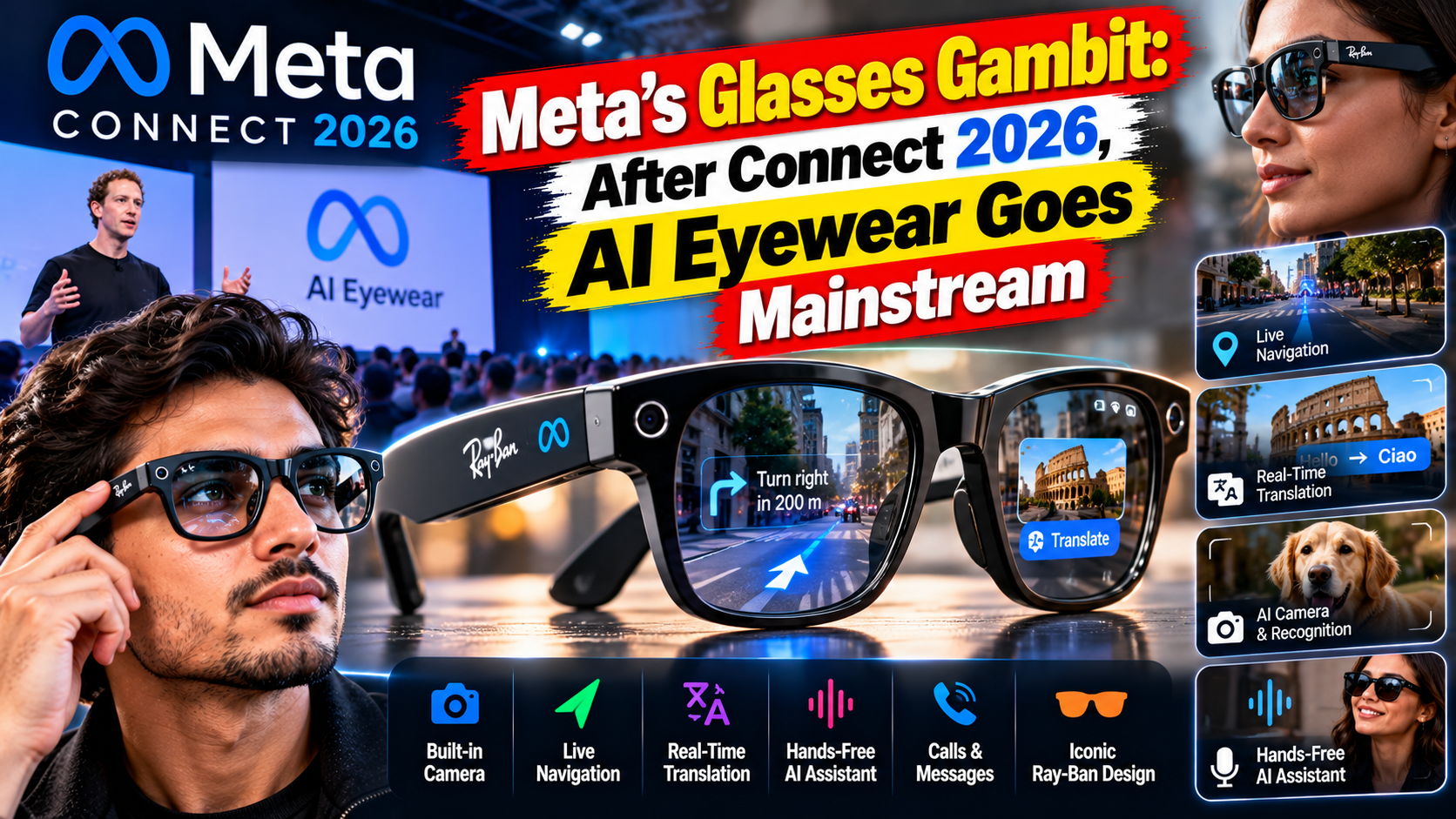
Meta had a September to remember — and October is keeping pace. At Connect 2026, the company unveiled four new AI glasses plus a personal AI agent called Muse. This week it donated 1,000 pairs of AI glasses to disability organizations in Singapore. And it banned TikTok from advertising across its platforms. Love Meta or hate it, nobody can accuse the company of standing still.
Connect 2026: Four Glasses, One Vision
The September 23 Connect event was Meta’s biggest hardware showcase yet, and glasses were the whole story. Four products: the Ray-Ban Meta Audio at $349 (camera-free, shipping October 13), the Ray-Ban Meta Gen 3 at $449 (12MP camera, 3K video capable), the Meta Adventurer at $249 (shipping October 23), and the platform play underneath — the Muse personal AI agent with voice interaction coming to the glasses.
The lineup strategy is clever. The $249 Adventurer is the gateway drug — cheap enough to be a gift or a curiosity buy. The $349 Audio is the privacy play: all the AI assistant benefits, no camera, aimed at people (and workplaces) uneasy about being recorded. The $449 Gen 3 is the flagship: full camera, best specs, the complete experience. Three prices, three comfort levels with cameras, one AI platform underneath it all.
Meta says 100+ glasses styles are planned by end of 2026. That’s the fashion play, and it’s the right one. Glasses sit on your face — they’re identity, not just utility. The Ray-Ban partnership was always about this: making AI eyewear you’d actually want to wear, not a gadget you tolerate. A hundred styles means a hundred chances to find the one that feels like you.
Muse: The Agent in Your Glasses
The hardware’s only half the story. Muse is Meta’s personal AI agent, and its arrival on glasses with voice interaction is the real long-term bet. The vision: an AI that sees what you see, hears what you hear, and helps in the moment — translating a sign, identifying a plant, reminding you of the name of the person walking toward you. We’ve all been there.
This is where Meta’s strategy splits from everyone else’s. Apple is building AI into the phone. Google is building it into the cloud and the assistant. Meta is betting the next computing platform sits on your face — that the phone was the transitional device and glasses are the destination. Bold thesis, and the company is spending like it believes it: Reality Labs losses are still enormous, but the glasses line is the first Reality Labs category showing real consumer traction.
The open questions are the obvious ones. Battery life — all-day wear with AI processing is brutally hard. Social acceptance — camera glasses still make people nervous. And whether voice-first interaction works in noisy real-world environments. Meta’s answer to the camera worry is partly the Audio model: no camera, no controversy. A pragmatic admission that technology and social norms are moving at different speeds.
1,000 Glasses for Accessibility
On October 7, Meta announced it’ll donate 1,000 Ray-Ban Meta AI glasses to four disability organizations in Singapore, along with $30,000 for accessibility training. This deserves more than a passing mention, because it spotlights the genuinely transformative use case for AI glasses: accessibility.
For blind and low-vision users, AI glasses with scene description are life-changing — reading signs aloud, describing surroundings, identifying objects. Be My Eyes and similar services proved the concept with human volunteers; AI makes it instant and always available. Meta’s donation puts advanced assistive tech directly in the hands of people who need it most, with funding to train them on it.
Smart strategy, too. Accessibility use cases build public goodwill and generate real product feedback from demanding users. The features developed for accessibility — better voice control, richer scene description, more reliable real-world AI — make the product better for everyone. The curb-cut effect, applied to AI eyewear.
Meta Bans TikTok Ads
In a sharper move, Meta banned TikTok and parent company ByteDance from advertising across its platforms, effective immediately as of October 8. The ban covers the US, Canada, Egypt, Indonesia, Japan, Thailand, and Vietnam — and extends to third-party advertisers linking to TikTok.
Corporate warfare, plain and simple. Meta and TikTok are the two fiercest rivals for young users’ attention, and advertising is both a revenue stream and a competitive weapon. Banning your rival from buying ads on your platform is the kind of move that invites regulatory scrutiny — and in today’s antitrust climate, with Meta already facing cases on multiple continents, it’s a bold call.
The country list is interesting: not global, which suggests calibrated legal strategy rather than blanket policy. The US inclusion matters most — Meta’s biggest ad market, and the one where TikTok’s future has been most politically contested. Opening shot of a broader platform war, or a one-off flex? Too early to say. But the signal to the industry is unmistakable: gloves off.
What Meta’s October Means
Put it together and Meta’s strategy is clearer than it’s been in years: own AI eyewear before Apple or Google get serious, build the agent (Muse) that makes the hardware indispensable, use accessibility to prove the human value, and fight the platform wars ruthlessly where it counts.
The risks are real. The glasses business still loses money overall. The TikTok ad ban could backfire legally. And the grand vision — glasses replacing phones — is years from reality, if it ever arrives. But for the first time since the metaverse pivot, Meta has a hardware story regular people can understand and buy: good-looking glasses that do useful things, starting at $249. Much easier sell than a $3,500 VR headset.
The question for everyone else in the industry: who answers? Apple’s reportedly building its own AI glasses. Google has Android XR and the Samsung partnership. The AI eyewear race is officially on, and Meta just took a clear lead. Can it hold that lead against Apple’s design machine and Google’s AI? That’s the story to watch through 2027. For more Meta and wearable coverage, see our Tech News and AI Tools sections.
Related Reading
Keep exploring: Smartwatch Buying Guide 2026: 6 Things That Actually Matter, Why Every Phone Brand Is Adding an AI Button in 2026, and ChatGPT vs Claude vs Gemini: Which AI Should You Actually Pay For?.