
iPhone Duo Launch Week: Apple’s First Foldable, a New CEO, and a Packed October
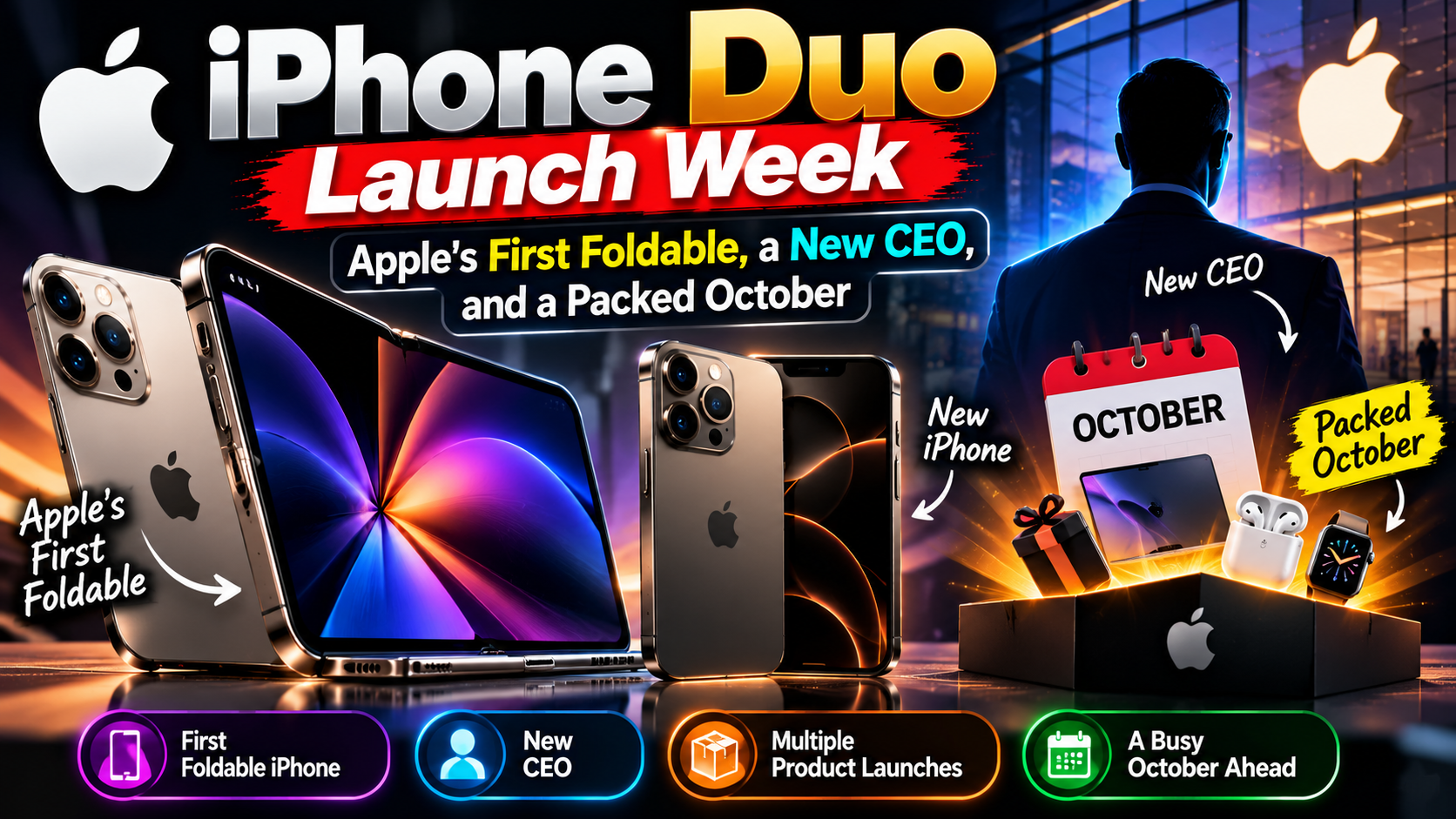
Apple is having one of the most consequential months in its modern history. Its first-ever foldable phone goes on sale. A new chief executive is settling into the top job. Two October events are stuffed with new hardware. And behind the scenes, the company reportedly came close to delaying its biggest launch. If you follow Apple, October 2026 is the month where everything happens at once.
The iPhone Duo Arrives
The headline is the iPhone Duo — Apple’s first foldable, announced September 9, on sale October 23 in more than 70 countries. Pre-orders open October 16 at 5am PT. Price: $1,999. The hardware: Apple’s A20 Pro chip, a 5.4-inch cover display, a 7.6-inch 120Hz inner OLED, running iOS 27.
Two grand is a lot for a phone — the most Apple has ever charged for an iPhone at launch. But Apple’s betting its entry legitimizes the whole foldable category, the way the Apple Watch did for smartwatches and AirPods did for wireless earbuds. The company has a long habit of arriving late to a category and then defining it: MP3 players, smartphones, tablets, smartwatches. Foldables are next on that list — if the bet pays off.
What makes the Duo interesting isn’t just the folding. It’s iOS 27’s foldable software. Apple’s had years to watch Android makers iterate on foldable UX and learn from their mistakes — multitasking layouts, app continuity between the cover and inner displays, dock behavior. Apple gets to ship the refined version on day one instead of the experimental one. Whether that refinement justifies a $1,999 entry price is the question every reviewer will wrestle with over the next month.
The Launch Almost Slipped
Now the drama: reports say Apple nearly pushed the Duo launch to late November over production issues. The company scraped together enough inventory to hold October 23 — but supply is expected to be tight.
Worth understanding why, because it says something real about foldable manufacturing. Folding displays are genuinely hard to produce at scale to Apple’s quality standards. Yield rates — the share of manufactured displays that pass quality control — are reportedly the bottleneck. Every foldable maker deals with this; Apple deals with it while shipping tens of millions of units instead of hundreds of thousands.
Practical advice: want a Duo at launch? Be ready at 5am PT on October 16. Going by every constrained Apple launch in history, the pattern is predictable — pre-orders gone within hours, delivery dates slipping into November and December, and you’ll be refreshing tracking pages. Not in a rush? Waiting until early 2027 gets you better availability plus the first wave of real-world durability reports. First-gen Apple products have a good track record, but a first-gen folding iPhone is still a first-gen product.
October’s Event Double-Header
As if a foldable launch weren’t enough, Apple’s holding two events this month. The first, dubbed “Welcome home,”, lands October 13 — smart home focus, with a new home hub, a refreshed HomePod mini, and a new Apple TV 4K expected.
Apple’s smart home push has been a long time coming. The company pioneered the concept with HomeKit, then watched Amazon and Google build bigger ecosystems while Apple moved at its own pace. A dedicated home hub — basically Apple’s answer to the Echo Show and Nest Hub — signals Apple is finally treating the home as a platform, not a pile of accessories. The timing makes sense: with Apple Intelligence maturing and a new Siri experience, the company finally has the AI backbone a smart home hub needs.
The second October event is expected around October 27, and it’s the Mac event: OLED MacBook Pro models, an OLED iPad mini, and M6 Macs all reportedly on the table. The OLED MacBook Pro is the one to watch — OLED on the Mac has been rumored for years, and pairing OLED’s perfect blacks with the MacBook Pro’s contrast could produce the best laptop display ever shipped. The M6 chip keeps Apple’s silicon cadence going — and in a year when Microsoft and Nvidia are pushing AI PCs hard, Apple needs its silicon story to stay ahead.
The New CEO Era
Hanging over all the product news is the leadership transition: John Ternus became Apple’s eighth CEO on September 1, 2026, succeeding Tim Cook, who moved to executive chairman. Only the third CEO transition in Apple’s modern history — Jobs to Cook in 2011, Cook to Ternus now — which tells you how seriously Apple takes continuity.
Ternus is an engineer’s engineer. He ran hardware engineering, including the iPhone and the Mac silicon transition. His promotion signals where Apple sees its future: deep hardware-software integration (the silicon advantage), not services or content. Cook’s legacy was operational excellence and the services build-out; Ternus’s challenge is product innovation in the AI era, where Apple has been seen — fairly or not — as playing catch-up.
Early industry reaction has been cautiously optimistic. Ternus is well-regarded inside Apple and known to developers. But Apple’s CEO doesn’t get judged on reputation — they get judged on products. The iPhone Duo launching seven weeks into his tenure is either a gift (a landmark launch to open his era) or a trial by fire (any stumble happens on his watch). Honestly? Probably both.
What It All Means
October 2026 is Apple placing several big bets at once: that foldables are ready for the mainstream, that the smart home is finally Apple’s to win, that OLED belongs on the Mac, and that a new CEO can steer the world’s most valuable company through the AI transition. Any one of these would be a major story on its own. Together, they’re a statement of intent — Apple under Ternus plans to move fast.
For shoppers, the practical takeaway is patience. The Duo will be supply-constrained and first-generation. The smart home hub is a version-one product in a category where Apple has stumbled before. The OLED Macs will be excellent and expensive. The smart money: let the early adopters beta-test October, then shop the refined lineup in spring. For ongoing Apple coverage, follow our Tech News section and mobile app picks.
Related Reading
Keep exploring: Why Every Phone Brand Is Adding an AI Button in 2026, Tablet vs Laptop 2026: Which Should You Buy? An Honest Buying Guide, and USB-C Won the Charger War: What It Means for Your Next Phone.