
Duolingo Review 2026: Is It Still Worth Your Time?
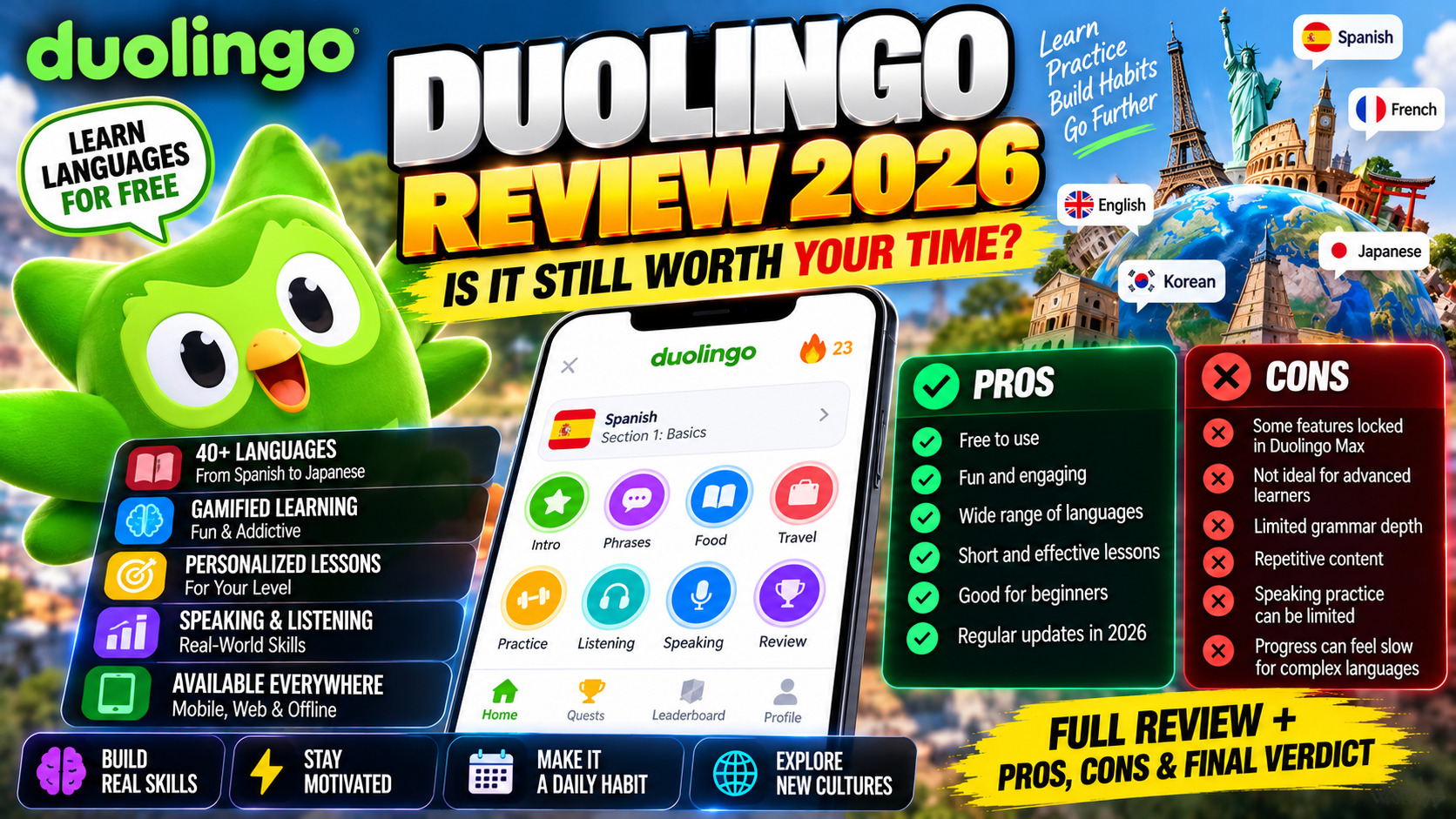
Duolingo is the world’s most popular way to learn a language. Over 100 million monthly users. An owl mascot with genuine meme status. A streak system that has ended friendships. But popularity isn’t effectiveness, and the language-learning community has argued about Duolingo’s actual teaching value for years. In 2026, with AI features layered on top and a decade of refinement behind it — is it still worth your ten minutes a day? This review looks at the method, the evidence on effectiveness, the free-versus-paid question, and where it fits among alternatives. Based on published features and independent research, not vibes.
The Method: Gamified Micro-Lessons
The core loop hasn’t changed: bite-sized lessons, five to ten minutes, built around translation, matching, listening, and speaking exercises — all wrapped in game mechanics. XP, streaks, leagues, gems, leaderboards. The 2026 app adds AI-powered extras: conversational practice with an AI tutor (roleplay scenarios like ordering food), personalized review sessions that target your weak words, and the Duolingo Max tier’s “Explain My Answer” feature.
The gamification is genuinely best in class. No learning app retains users like Duolingo. The streak system builds a daily habit, and that habit is arguably the product. The question is what the habit produces.
Does It Actually Work? (The Evidence)
Honest answer: partially. Depends on your goal. Independent studies — including Duolingo-commissioned research and third-party academic work — find that consistent use builds solid beginner vocabulary and basic grammar. Roughly a semester of college language study for dedicated users over several months. That’s real value.
The limitations are equally well documented. The app under-teaches spontaneous conversation — multiple choice doesn’t prepare you for a native speaker talking fast. Grammar explanations are thin; you absorb patterns by repetition without understanding the rules. Advanced learners hit a ceiling: Duolingo takes you to roughly B1, intermediate, not fluency. Fair summary? Excellent start, poor finish. It builds the foundation. It doesn’t build the house.
Free vs Super vs Max (2026 Tiers)
The free tier is still remarkably generous — the full course content costs nothing, supported by ads and limited “hearts.” Mistakes cost hearts; run out and you wait or practice. Super, the mid-tier subscription, removes ads, gives unlimited hearts, adds offline lessons. Worth it if the ads and heart system drive you mad — roughly a coffee a month.
Max, the premium tier, adds the AI features: roleplay conversations and video-call-style practice with the AI tutor. Is Max worth it? The AI conversation practice is the closest Duolingo gets to real speaking practice, and reviewers find it genuinely useful. Still no substitute for human conversation, though. My take: start free. Upgrade to Super if you’re still committed past month two. Consider Max only if speaking practice is your priority and you can’t get a tutor or exchange partner. Check current pricing and features at Duolingo’s official site — tiers evolve.
Strengths: What Duolingo Gets Right
Four things no competitor matches. Habit formation. The streak system gets people practicing daily for months — and daily practice beats brilliant methods used weekly. Accessibility. Genuinely free, runs on any phone, 40+ languages including smaller ones (Welsh, Hawaiian, Zulu) you’d never find in a classroom. Beginner onboarding. The first weeks are perfectly paced — zero intimidation, constant wins. Consistency of updates. Course content and AI features improve every year; the 2026 app is meaningfully better than the 2022 one.
For a casual learner wanting basic conversational ability for travel or fun, Duolingo alone might actually suffice.
Weaknesses: Where It Falls Short
The criticisms are fair, so let’s be straight about them. Speaking. Repeat-after-me exercises don’t teach you to construct sentences under pressure — which is the actual skill of conversation. Grammar. Minimal explicit explanation. You absorb patterns without understanding rules, and that breaks down at intermediate level. Weird sentences. Better than before, not gone — “the bear drinks beer” energy persists, optimized for engagement over utility. The ceiling. After 6–12 months of daily use, progress slows hard. The app isn’t designed to take you to fluency. Distraction design. The gamification that hooks you can also hijack you — leagues and gems optimize for app engagement, not learning outcomes.
Use Duolingo as a tool, not a game. The moment you’re grinding XP instead of learning, step back.
The Best Alternatives (and Complements)
Duolingo works best as part of a stack. For conversation: iTalki or Preply — human tutors from around $5 an hour. One weekly session does more for speaking than a month of app exercises. For vocabulary: Anki, free spaced-repetition flashcards — the science-backed method Duolingo approximates. For grammar: a proper textbook, or Kwiziq for French and Spanish. For immersion: graded readers, podcasts, Netflix with target-language subtitles. AI alternative: ChatGPT or Claude as conversation partners — free, infinitely patient, surprisingly effective.
The winning formula most polyglots recommend: Duolingo for the daily habit, Anki for vocabulary, weekly human conversation, media immersion on top. That stack gets you to real fluency. Duolingo alone doesn’t.
Duolingo for Kids, Schools, and Families
Quick mention for parents and teachers: Duolingo ABC (young kids learning to read) and Duolingo for Schools (free classroom tools) extend the ecosystem well beyond solo adult learners. The family plan bundles multiple Super accounts at a discount — sensible if the whole household is learning.
Funny thing: the gamification critics call distracting is actually ideal for kids. Children engage with streaks and rewards far more readily than textbooks. If you’re evaluating it for a child, the free tier plus your involvement — practicing together, celebrating streaks — works well. And for more ways to use AI in learning, explore our AI Tools section.
Verdict: Who Should Use It?
Use Duolingo if: you’re starting a language from zero, you want a free daily habit, you’re learning for travel or fun, or you need structure to stay consistent.
Skip it — or move past it — if: you’re already intermediate (you’ve outgrown it), your goal is fluent conversation (you need humans), or the streak pressure stresses you out. It’s okay to quit an app that makes you anxious.
Score: 8/10 as a beginner tool, 5/10 as a complete solution. The owl deserves respect — it gets millions of people learning every day, which no textbook ever managed. Just know what it’s for, use it daily, and graduate to real conversation when you’re ready. For learning resources and app guides, see our Tutorials section and Duolingo’s help center.
Related Reading
Keep exploring: 7 Ways Students Use AI to Study Smarter (Without Cheating), 5 Best Free File Manager Android Apps in 2026, and 5 Free Photo Editing Apps for Android That Beat Paid Ones.