ElevenLabs Eleven v4 Review: The AI Voice That Acts, Not Just Reads
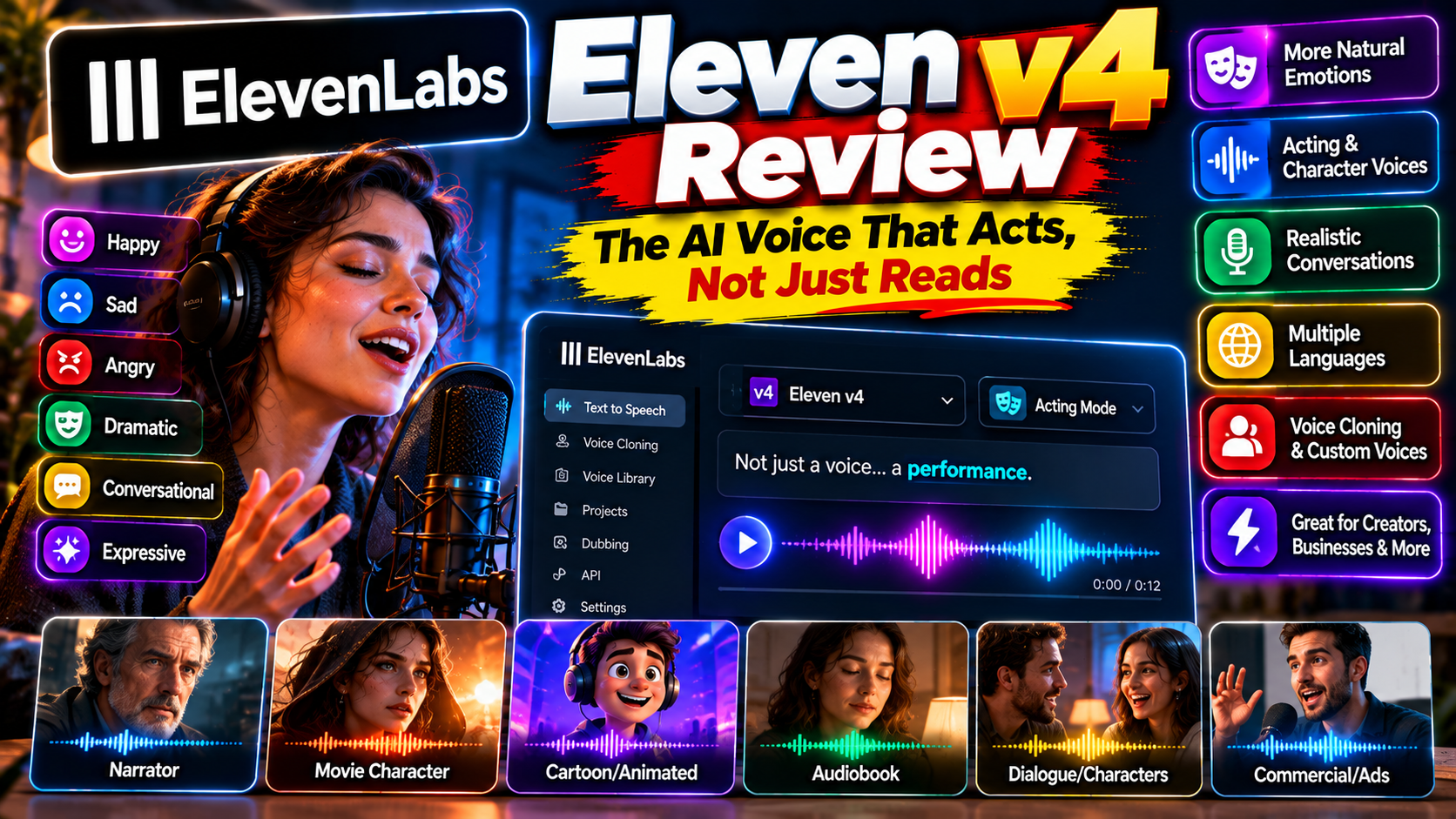
AI voices used to read. Now they perform. ElevenLabs launched Eleven v4 and Eleven v4 Turbo on September 28, 2026 — a ground-up rebuild of its text-to-speech architecture — and the pitch is a leap from “text reader” to “voice actor.” We dug into the launch claims, the independent benchmarks, and the fine print so you know what’s real.
One honest note up front: this is desk research, not a hands-on test. We read the launch materials, third-party coverage, and benchmark data — we didn’t run the model ourselves. Treat scores below as reported, not verified by us.
What Launched
Two models, two jobs. Eleven v4 is the quality-first model — audiobooks, dubbing, character voiceovers, ads, anything you produce once and publish. Eleven v4 Turbo is the low-latency sibling for voice agents and live conversations, where every hundred milliseconds of delay is a UX problem. Both support 90+ languages (up from 70+ in v3), with the biggest reported quality jumps in Japanese, Brazilian Portuguese, Mandarin, and Cantonese. Both are available on the free tier. A solid technical overview lives at Lapaas Voice’s launch breakdown.
What’s Actually New
- Direction in plain English: you write tags like
[whispers],[nervous laugh], or[door slams]right into the script — emotion, pacing, even sound effects. Tags stack in sequence now, which v3 couldn’t reliably do. - Multi-speaker scenes: dialogue is generated as a scene rather than stitched-together solo reads, so characters actually respond to each other.
- 10-second voice cloning: Instant Voice Clones need just 10 seconds of reference audio. Professional Voice Clones — dropped in v3 — are back, carrying the full emotional range.
- Speaker stability: regenerate one line and the voice doesn’t drift into a different person. Boring-sounding, but it’s what makes long projects viable.
- SSML is out: classic SSML controls like the break tag are disabled in v4, replaced by the natural-language tags. Some developers will grumble.
The Numbers (and How Much to Trust Them)
The strongest independent number: Artificial Analysis ranks Eleven v4 #1 on its Provider Voice TTS Arena (Elo 1,319, ahead of Cartesia and Google’s Gemini Flash TTS), #1 for pronunciation robustness. Blind listeners preferred it roughly three times out of four. That’s a third-party evaluator, not ElevenLabs grading its own homework — the best apples-to-apples number the industry has.
The latency claim — ~150ms median time to first speech for Turbo — is vendor-measured over WebSocket with network delay subtracted. Real-world waits will be longer. And ElevenLabs’ own “wins 65–81% of blind preference tests” chart is, well, ElevenLabs’ own chart. Impressive, but read it as marketing with a benchmark attached.
The Catches
Three things worth knowing before you dive in. First, cloning requires verified consent from the voice’s owner — ElevenLabs enforces this, and rightly so, given how trivial 10-second cloning makes impersonation (see our AI voice scam guide). Second, free-tier testing isn’t a commercial license — check plan terms before using output in paid work. Third, generated audio still needs a human listen: pronunciation quirks and emotional misfires happen, especially with specialized vocabulary.
Who Should Try It
Making videos, podcasts, audiobooks, or multilingual content? The free tier is genuinely worth an afternoon — the expression tags alone are fun to play with. Building a voice agent? Turbo’s latency story is the one to evaluate, but test it on your own network before committing. Just need an occasional voiceover? The free tier probably covers you without spending a cent.
Verdict: v4 looks like a real step forward for expressive AI speech, backed by the strongest independent benchmark in the category. The vendor claims deserve the usual discount, but the direction — voices that act, not just read — is unmistakable. For more voice AI, see our voice generator tests and AI image generator comparison.
Related Reading
Keep exploring: AI Voice Generators Tested: Which Sounds Most Human?, Best AI Apps for Android and iPhone in 2026, and 7 Ways Students Use AI to Study Smarter (Without Cheating).