
Apple Releases Depth Pro 2 — Metric 3D Depth From Any Photo or Video
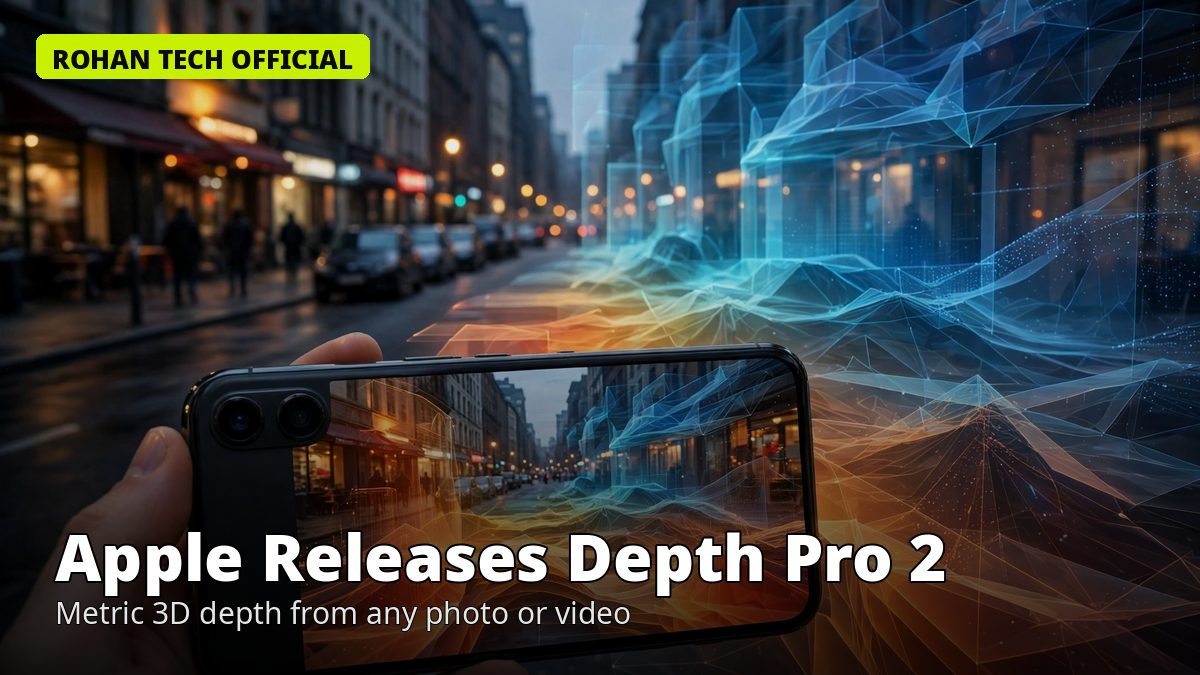
Apple has released Depth Pro 2, a model that turns an ordinary photo or video into a full 3D depth map measured in real metres. Announced on November 19, 2026, in the paper “Depth Pro 2: Sharp and Temporally Consistent Metric Monocular Depth” (arXiv 2611.26603), it estimates metric depth — a distance in metres — for every pixel, from a single photo, a whole video, or a live camera feed, at the input’s full resolution.
Depth estimation from a single camera is a hard problem. A flat image does not record how far away things are, so a model has to infer distance from clues in the scene: size, perspective, occlusion, and texture. Depth Pro 2 takes that on with one model that handles both still images and video, and it reports its answers in metres rather than in relative terms, which makes the output usable for work that needs real measurements.
How It Works
Depth Pro 2 is built around one scalable network that combines a multi-view transformer with a DPT decoder. The same network handles images and video, which keeps the design simple: one model, one way of working, whether the input is a single frame or a moving sequence.
That shared design matters for video in particular. Many depth models treat each frame on its own, which can make the depth flicker as the scene moves. A network built to look across views can keep its answers steady from frame to frame, and temporal consistency is one of the two qualities Apple highlights for this release.
Four Sizes, One Job
Depth Pro 2 comes in four sizes, and each size has its own repo on Hugging Face. The S model has 24 million parameters and weighs 97MB. The B model has 97 million parameters and weighs 386MB. The L model has 334 million parameters and weighs 1.3GB. The H+ model, the default and the best quality option, has 872 million parameters and weighs 3.5GB.
That range gives users a real choice. The small models will run where memory and compute are tight, while the large ones trade size for quality. Picking between them is a matter of what the machine can handle and how sharp the depth map needs to be, and having four rungs on the ladder makes that choice easy to tune.
Alongside the depth models sits a shared focal-length estimator, with 23.5 million parameters and a size of 94MB. Its job is to predict the camera’s focal length when that value is unknown, which is the usual case with photos and videos taken on an ordinary camera. Getting the focal length right matters because it shapes how the model reads perspective in the image, and a wrong guess there would skew the depth it reports.
Video Mode: Two Ways to Run It
Video can run in two modes. The first uses buffered clips of 16 frames with a 4-frame overlap, so each clip shares a few frames with the next one and the depth stays smooth across the join. The second is per-frame streaming, where frames are handled one at a time as they arrive.
The buffered mode suits recorded video, where the whole clip is there to work with and consistency across the full sequence is the goal. The streaming mode suits live use, where the next frame has not arrived yet and the model has to keep up with the feed. Having both means the same model can serve a video file on disk and a camera feed in real time.
Where It Runs
Depth Pro 2 runs on an NVIDIA GPU with CUDA in bfloat16, on an Apple silicon GPU through MPS, or on a CPU in float32. That spread covers the machines most people actually have: a PC with a discrete GPU, a Mac with Apple silicon, or a plain CPU when no GPU is available. Core ML exports are also on Hugging Face, which opens the door to running the model through Apple’s own machine learning stack.
The repo also includes a Mac live-depth demo, so Mac users can point a camera at a scene and watch the depth map appear in real time. That kind of demo is often the fastest way to judge a depth model, since a live feed shows flicker and edge errors at once, in a way a still image cannot.
What Apple Says It Does Better
Apple says Depth Pro 2 beats prior work on two measures: sharpness, judged by Boundary F1, and temporal consistency, judged by Jitter. Sharpness is about edges: a good depth map should keep a sharp line where one object ends and another begins, instead of smearing the boundary. Temporal consistency is about stability: the depth of a still object should not wobble as the video plays.
Those two qualities are the ones users notice first. A depth map with soft edges looks wrong around hair, railings, and thin objects. A depth map that jitters looks wrong the moment anything moves. Apple’s claim is that Depth Pro 2 is stronger on both than the models that came before it, and the live demo is the easiest place to put that claim to the test.
The Licence Catch
There is one catch, and it is a big one for anyone planning to build a product on this. Depth Pro 2 is released under the Apple Machine Learning Research Model licence, which allows research use only. It is not a commercial licence, so the model cannot be used in a product that makes money.
That does not make the release useless — far from it. Researchers can use it freely, compare it with their own work, and build on what it shows. But a company that wants metric depth in a shipping app will need to look elsewhere, or negotiate a different arrangement. The code itself is on GitHub, in the apple-aiml-research/ml-depth-pro-2 repo, and the model weights are on Hugging Face at apple/DepthPro2. Apple’s own research page for the model is at machinelearning.apple.com.
Depth estimation has been moving fast, and this release shows how far a single-camera setup can now go. For related reading, our piece on Picsart’s creative AI platform and API looks at another set of tools turning images into something new, and our report on Gemini computer use on Mac covers AI that works directly with what is on screen. Both sit in the same widening field: AI that reads images and video, and does something useful with what it sees.
For researchers, the next step is simple: try the demo, test the model on your own footage, and see whether the sharpness and steadiness hold up outside Apple’s test set. For everyone else, Depth Pro 2 is a clear sign of where single-camera 3D is heading — and a reminder to read the licence before building on it.