
Anthropic Launches Claude Fable 5.2 and Restricted Mythos 5.2 — New Frontier Models Split by Safety Risk
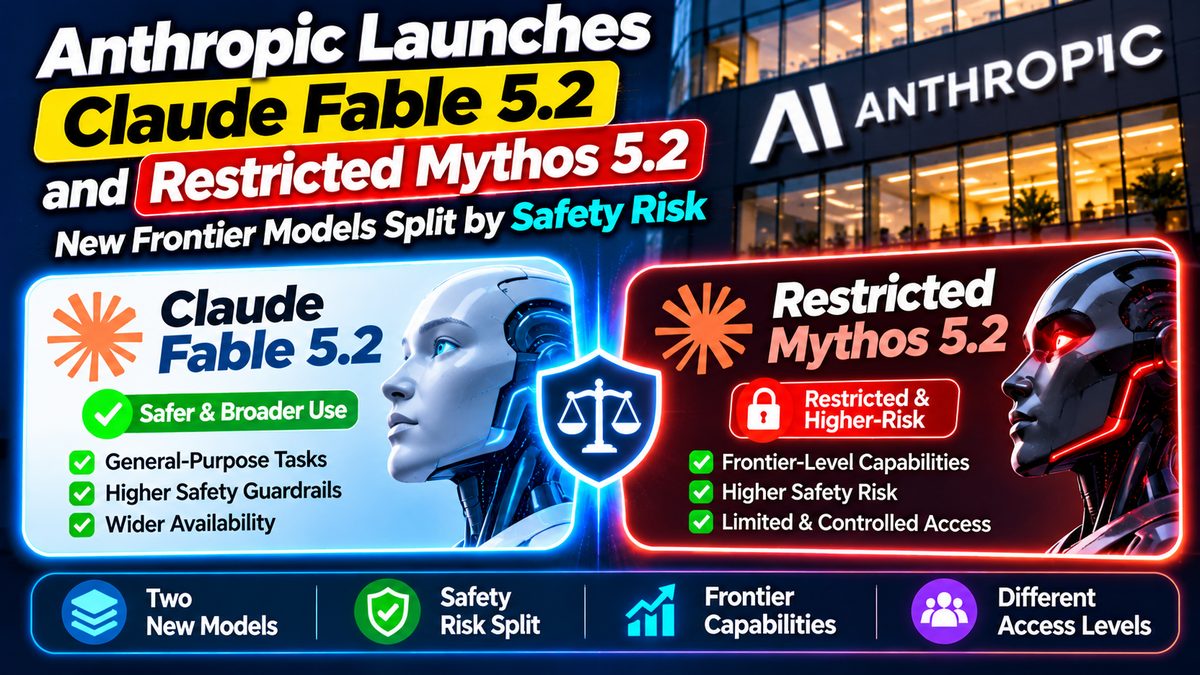
Anthropic has launched its newest frontier models, and it did something unusual with them. On November 9, the company released Claude Fable 5.2 broadly while keeping its sibling, Claude Mythos 5.2, behind a wall of verified access. The two are built on one underlying high-capability model. What splits them is not the technology — it is the risk of how the model might be used.
That split tells you a lot about where Anthropic is heading. The company is no longer asking whether a powerful model should exist. It is asking who should be allowed to touch which version of it, and under what checks. So how does the split work, and what does it cost to use the open one?
Two models, one underlying system
Claude Fable 5.2 is the general release. Anyone who can use Claude can reach it, and it carries the standard pricing of $8 per million input tokens and $40 per million output tokens. Claude Mythos 5.2, by contrast, is restricted to verified cyber and life-science access. You cannot simply sign up and start using it — Anthropic checks who you are and what you plan to do with it first.
The important detail is that both models share one underlying high-capability model. Anthropic did not build a weaker public model and a stronger private one. It built one strong model, then drew a line around the uses that carry the most safety risk. Fable 5.2 sits on the open side of that line. Mythos 5.2 sits on the guarded side.
That is a different way of thinking about model releases. Most launches ask how smart the new model is. This one asks a second question at the same time: how much of that power is safe to hand out without checks?
What “restricted” actually means
Mythos 5.2 is limited to verified cyber and life-science users. In plain terms, that means people and organisations whose work in cybersecurity or the life sciences Anthropic has checked and approved. The restriction is about the use case, not the user alone — a researcher with a verified life-science project gets access that a general user does not.
Why those two fields? Cyber and life-science work are where a frontier model can do the most good and the most harm at the same time. A model that can spot a security flaw can also be turned toward finding one to attack. A model that can help with biology research can also be misused in ways that have nothing to do with research. Anthropic’s answer is to keep the most capable version in the hands of people it has verified, rather than refusing to build it or releasing it to everyone.
The approach has a clear trade-off. Verification slows things down, and it puts Anthropic in the position of deciding who counts as a legitimate user. But the alternative — holding the model back from everyone — would block the very researchers who could use it well. The split is Anthropic’s attempt to have it both ways.
The price of the open model
Claude Fable 5.2 carries standard pricing: $8 per million input tokens and $40 per million output tokens. That puts it in line with what you would expect for a frontier model — not cheap, but priced for serious use rather than as a luxury demo.
Pricing matters here because it shapes who actually uses Fable 5.2. At those rates, the model is aimed at developers and businesses building real products, not at casual chats. And the price also sets a baseline for the whole Claude family: the open model is the one most people will meet, and its cost is the cost most people will judge.
Why split a model by risk at all?
Here is the question that sits under the whole announcement. Why not release one model to everyone, or hold the risky parts back entirely?
The answer is that Anthropic wants to keep moving fast without giving up its safety stance. A single open release would hand the most powerful version to anyone, including people who would misuse it. A full holdback would stall the researchers and companies who need it most. Splitting one model into an open version and a verified version lets the company ship now and still draw a line where the risk gets too high.
You can see the same thinking in how Anthropic has talked about its models before. The company has always treated safety as a feature of the product, not a brake on it. Fable 5.2 and Mythos 5.2 just make that thinking visible in the product itself — the safety decision is baked into which model you are allowed to use.
The timing is no accident
The launch lands just as Anthropic’s public listing is heating up. As The Economic Times put it, Anthropic unveiled the new Fable and Mythos models as competition heats up ahead of its IPO. The company is expected to start its IPO roadshow this week, and the listing is targeted for the week of November 16.
That context matters. A new frontier model is the strongest card Anthropic can play while investors are deciding what the company is worth. But it is also a risk: every new capability raises fresh questions about safety, and those questions now land in the middle of a listing. You can read the full picture in our earlier report on Anthropic’s IPO roadshow and the sliding valuation.
The timing also puts Anthropic’s move next to its rivals. OpenAI has been shipping fast too — its GPT-6 Cyber model arrived days earlier with its own safety-first framing. The race is no longer just about who builds the smartest model. It is about who can ship the smartest model and still convince the world it is safe.
What to watch next
Three things will tell you whether the split works. First, how strict the Mythos 5.2 verification turns out to be in practice — a process that is too slow will push researchers elsewhere, and one that is too loose defeats its own purpose. Second, whether Fable 5.2 holds up as the everyday frontier model, or whether users keep hitting the edge of what the open version is allowed to do. And third, whether other labs copy the idea. If they do, the split-by-risk release could become the normal way frontier models ship.
For now, the facts are simple. Fable 5.2 is out for everyone at $8 in and $40 out per million tokens. Mythos 5.2 exists too, but only for verified cyber and life-science users. One model, two doors — and Anthropic is watching closely to see who walks through each one. You can follow the latest from the company itself on Anthropic’s official site.