Ideogram 4.6 Brings Native 4K Image Editing — Precise Edits, Less Pixel Drift
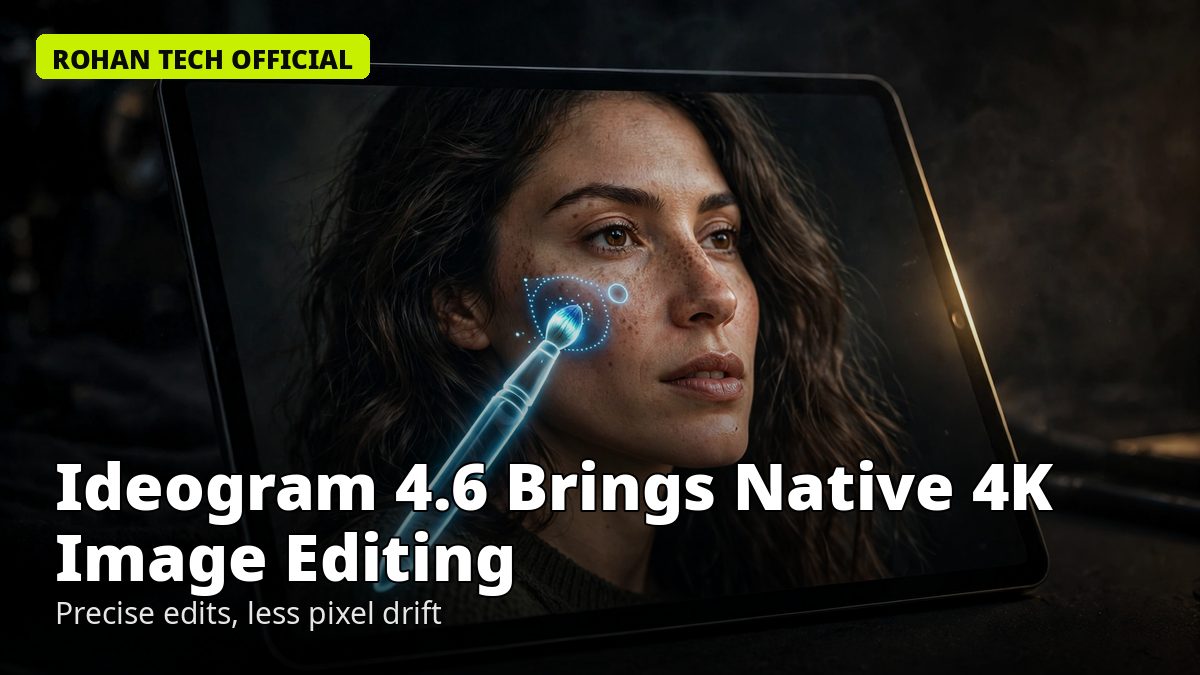
Editing an AI image has always had a quiet flaw: change one thing, and the rest of the picture shifts a little. Colours drift, textures soften, a face you liked comes back slightly different. Ideogram’s new model is built to fix that exact problem. Ideogram released Ideogram 4.6 on November 19, 2026, the successor to Ideogram 4.5 from September 30, 2026. It’s an image generation and editing model built for precise creative control, with output up to 4K — up to 4096 by 4096 pixels — generated natively at full resolution, with no upscaling step in between.
Native 4K, not upscaled 4K
The headline number is the resolution, but the way it’s reached is the part that counts. A lot of tools can hand you a 4K file by rendering small and scaling up, which smooths fine detail and leaves edges soft. Ideogram 4.6 generates natively at full resolution, so the detail in the file is detail the model actually drew.
The model covers both generation and editing in one place. You can start from a text prompt, or bring an existing image and ask for a change. That second half — editing — is where Ideogram aimed most of the new work: less drift outside the edited area, and colours that stay true to what you asked for.
Edits that leave the rest of the picture alone
Pixel drift is the annoyance every editor knows. You ask for a red jacket instead of a blue one, and the wall behind the subject changes shade, or the person’s hands come back redrawn. Ideogram says 4.6 cuts that drift down, so the parts of the image you didn’t touch stay as they were. Colour accuracy gets a matching claim: in Ideogram’s own tests, exact-colour usable results rose from 46% to 83% between 4.5 and 4.6. That’s a vendor-reported figure, not an independent benchmark — but colour is one of the easiest things to check with your own eyes on a first test.
Character consistency gets a similar vendor-reported improvement: 85% on 4.6 against 69% on 4.5. If you work with a recurring character — a mascot, a model, a comic figure — that number is the one to watch. Again, these are Ideogram’s own figures, so treat them as a claim to verify in your own edits rather than a settled fact.
How the editing tools work
Ideogram 4.6 ships with Generate and Precise Edit API endpoints, so developers can wire generation and targeted edits into their own apps. The Precise Edit endpoint takes an optional mask, which lets you paint the area you want changed and limit the edit to that region. That’s the practical answer to pixel drift: instead of trusting the model to guess what should stay fixed, you draw the boundary yourself. Multi-turn editing builds on the same idea — each result becomes the source for the next edit, so you can refine a picture step by step instead of starting over when one detail is off.
Transparent PNG output is in there too, which matters for designers who need a subject on a clear background for a layout or a mockup. You get the cut-out straight from the model, without a separate background-removal pass. The model is available in the Ideogram app and API, and through partners including Leonardo, Runway, fal and Comfy. For more on the wider AI image space, see our reports on Picsart’s creative AI platform and Inkling 2 Mini, a local AI model.
Leaderboard claim and pricing
Ideogram says 4.6 ranks first on Rapidata’s Multi-step Image Edit leaderboard at 1,892 (snapshot November 17, 2026), with 4.5 second at 1,866. Note that this is a vendor-published leaderboard claim — Ideogram’s own announcement of its ranking — so treat it as the company’s statement, not an outside verdict. The gap between the two scores is small, and a leaderboard snapshot can move.
Pricing is per image and varies with quality and resolution. Generations run from $0.008 to $0.20 per image, while edits go up to $0.60 for a high-quality 4K edit. Prices at 2K match 4.5, so if you were already editing at that size, the step up to the new model doesn’t change what you pay there. The 4K edit price is the one to budget for: sixty cents a shot adds up fast across a long series, so save the top resolution for finals and use cheaper sizes while you’re still trying ideas out.
Open weights are coming — with no date yet
One more detail from launch day: Ideogram said on X on November 19 that it will “skip 4.5 open and go directly to 4.6 open.” That’s intent only — no date, no licence and no download location were given, so don’t plan a local workflow around it until those details land. Until then, the model lives in the Ideogram app, the API and its partners, as listed on the Ideogram 4.6 model page, with more launch coverage at i10x. For another recent AI release, see our piece on Amazon Polly voice cloning. Start with a small edit on an image you know well, mask the area, and check the untouched parts first. That’s the test that tells you whether 4.6 does what it claims.