
NVIDIA Unveils GR00T 2 — A Robot Foundation Model That Learns From Human First-Person Video
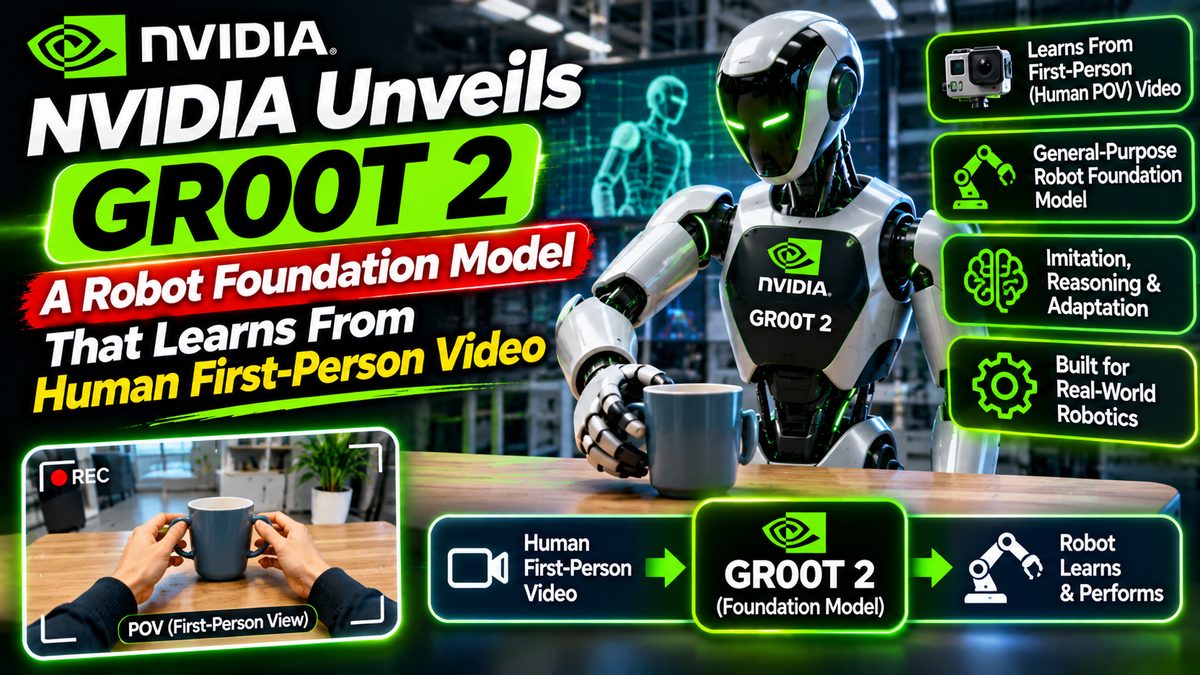
NVIDIA has a new robot brain, and it learns the way people do: by watching. On November 9, 2026, the company unveiled GR00T 2, a robot foundation model that learns manual manipulation skills from human first-person video. The announcement came at the Conference on Robot Learning (CoRL) in Austin, Texas, alongside Isaac Lab 3.0, NVIDIA’s updated simulation tools for robotics. Code is promised in December.
So what does that actually mean? In plain terms, GR00T 2 studies footage shot from a person’s point of view — hands reaching, gripping, lifting — and turns what it sees into skills a robot can use. The robot learns from watching people do ordinary physical jobs, instead of being programmed move by move.
What GR00T 2 actually does
A foundation model is a large model trained on broad data, then adapted to specific jobs. In robotics, that idea is still young. Most robots today are built for one task in one setting: a warehouse arm that moves boxes, or a vacuum that maps a floor. A foundation model aims higher — one model that picks up many different manipulation skills and adapts them to new objects and new rooms.
GR00T 2 feeds that idea with first-person video. When a person wears a camera and goes about a task, the footage shows exactly what the hands see: the grip, the angle, the order of movements. That view lines up neatly with what a robot’s own cameras see when it tries the same job. The match between the training view and the robot’s view is the whole point — the model does not have to translate a third-person video into its own body.
Why first-person video matters
Robot data is hard to collect. A robot has to be in the room, running the task again and again, and every hour of that costs time and hardware. Human video is far easier to gather — first-person footage of everyday tasks needs little more than a head-mounted camera.
That is the bet behind GR00T 2: if a model can learn manipulation from watching people, the training data problem gets much smaller. Instead of teaching a robot each skill from scratch, you show it how humans already do the job. Will it work for every task? Nobody can say yet. The December code release is when outside researchers get their first real chance to test the claim.
Isaac Lab 3.0 joins the launch
GR00T 2 did not arrive alone. NVIDIA also showed Isaac Lab 3.0, the next version of its simulation tools for robotics, at the same event. Simulation matters because robots are costly to train in the real world — a mistake can break the robot or the room. In simulation, a robot can practise a task thousands of times, fail safely, and only then move to the real thing.
The pairing makes sense: a model that learns from human video, plus a simulator where it can rehearse what it learned. Learn from people, practise in simulation, act in the real world — that is the pipeline this launch is built around.
Robots are moving out of the lab
The timing fits a wider shift. Humanoid robots have gone from research curiosities to serious products in a couple of years, and the big tech companies all want a stake. This site covered LG’s home humanoid robots on October 30 — a different company and a different announcement from GR00T 2, but part of the same move toward robots in everyday spaces, not just factory floors.
Tesla is reshaping its plans around AI, too. The company is winding down Cybertruck production around mid-2027 to free up factory space for its Cybercab robotaxi and its AI work. Cars, robots, chips — the lines between them are blurring, and GR00T 2 sits right at the crossing point.
And it is not just the physical world. AI models are taking on expert work in software as well: OpenAI’s GPT-6 Cyber, launched days earlier, hunts for security flaws in code. One model learns to spot bugs in Linux, another learns to pick things up with robot hands. The pattern is the same — train a big model on a rich source of examples, then point it at real work.
What to watch next
December is the first checkpoint. NVIDIA has promised the code then, and that is when the claims get tested by people outside the company. Watch for three things: how much of the model is released, what researchers manage to teach robots with it, and whether the first-person-video approach holds up beyond the tasks NVIDIA chose to show. Watch NVIDIA’s blog for news of the December release.
Until then, GR00T 2 is a clear statement about where robotics is heading: robots that learn by watching people, practise in simulation, and take on the small physical jobs that fill a normal day. The question is no longer whether robots can learn from us — it is how fast, and how well.