
Samsung’s Gemini-Powered Smart Glasses Open Pre-Orders From $395
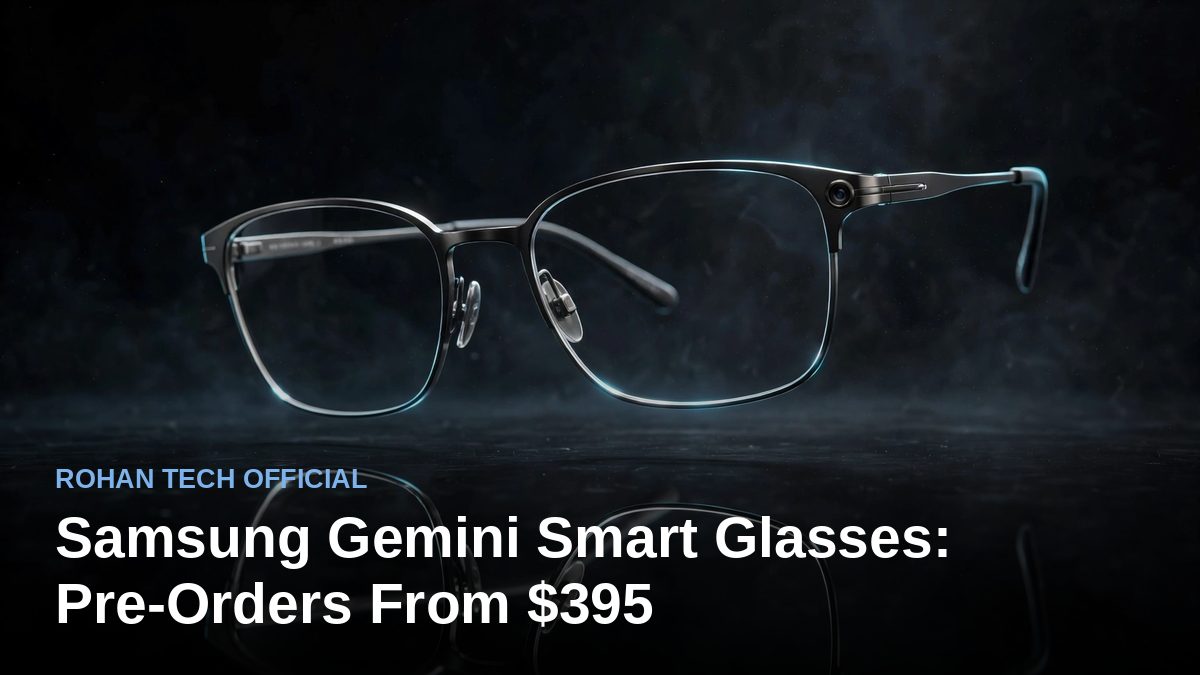
Samsung has opened pre-orders for its first smart glasses, and the pitch is refreshingly simple. There’s no screen in front of your eyes. Instead, you get a camera, speakers, microphones and Google’s Gemini assistant doing the heavy lifting. The glasses start at $395, according to reports from TalkAndroid, TechInKey and Geeky Gadgets published on November 12, with US sales set to begin on December 10.
That makes this one of the more interesting hardware bets of the year. Rather than chasing a display you can read notifications on, Samsung and Google are selling an assistant you wear — eyewear that listens, sees what you see, and answers back.
Android XR “Intelligent Eyewear”, Built With Google
The glasses run on Android XR, Google’s platform for extended-reality devices, and Samsung is positioning them as “Intelligent Eyewear” rather than a shrunken headset. Gemini sits at the centre of the experience. Ask a question out loud, and the assistant responds through the frames. Point your head at something, and the built-in camera gives Gemini the context it needs to be useful.
Under the hood, the glasses run on Qualcomm’s Snapdragon AR1 Gen 1 chip, silicon designed specifically for smart eyewear. It’s the kind of detail that matters more than it sounds. Glasses have tiny batteries and nowhere to hide heat, so a purpose-built chip is what decides whether a product like this lasts a full day or dies before lunch. Samsung hasn’t turned this into a specs war, and honestly, that’s probably the right call for a first generation.
A 12MP Camera, and No Display at All
The hardware list is short and deliberate. There’s a 12MP camera for photos, video and feeding visual context to Gemini. There is no display in the lenses — none. Everything comes back to you as audio.
Is that a limitation or the whole point? Display glasses exist, but they tend to be heavier, pricier and harder to wear all day without looking like you’re testing prototype hardware. An audio-first design keeps the frames closer to ordinary glasses in weight and appearance, and it keeps the price at a level that undercuts most display-equipped rivals. The trade-off is real, though: anything you’d normally glance at — directions, messages, translations on screen — has to work as a spoken answer instead.
We’ve seen Google lean hard into Gemini’s reasoning lately, from benchmark-topping models like the one in our Gemini 4 Carbon coverage to experimental workspace tools like Google Labs’ Tabletop. These glasses are where that software push meets your face.
The Fashion Brands Are Doing Real Work Here
Perhaps the smartest decision in the whole product is who designed the frames. Samsung worked with Warby Parker and Gentle Monster, two names people already buy glasses from for how they look, not what they compute. Smart glasses have a long history of failing the mirror test — technically impressive, socially unwearable. Partnering with established eyewear brands is a direct answer to that problem.
It also signals who Samsung thinks the buyer is. Not the developer, not the early-adopter hobbyist, but someone choosing frames the way they’d choose any other pair, with the AI features riding along. If the frames look wrong on a shop shelf, nothing Gemini can do will save them.
There’s a privacy angle baked into this design too. A camera that sits at eye level, ready to feed an AI assistant, will make some bystanders uneasy — that’s been true of every camera-equipped pair of glasses so far. How visibly Samsung signals recording, and how much control wearers get over what’s captured and shared with Gemini, will shape how welcome these feel in everyday places like offices, cafés and public transport.
Price, Dates and What to Watch
As reported, pre-orders start from $395, and US sales begin December 10. That price puts the glasses within reach of people who’d never consider a full XR headset, which seems to be exactly the idea. Samsung’s own newsroom is the place to watch for the official launch material as the date approaches — the Samsung Global Newsroom and the main Samsung site will carry the final retail details.
Plenty of questions remain open. Battery life, privacy signals for that always-available camera, and how well Gemini handles noisy real-world conversations will decide whether this becomes a daily-wear product or a novelty. But the strategy is clear enough: make the assistant the product, keep the glasses looking like glasses, and let the screen stay in your pocket where it belongs.