
How to Grow on YouTube in 2026: 12 Strategies That Actually Work
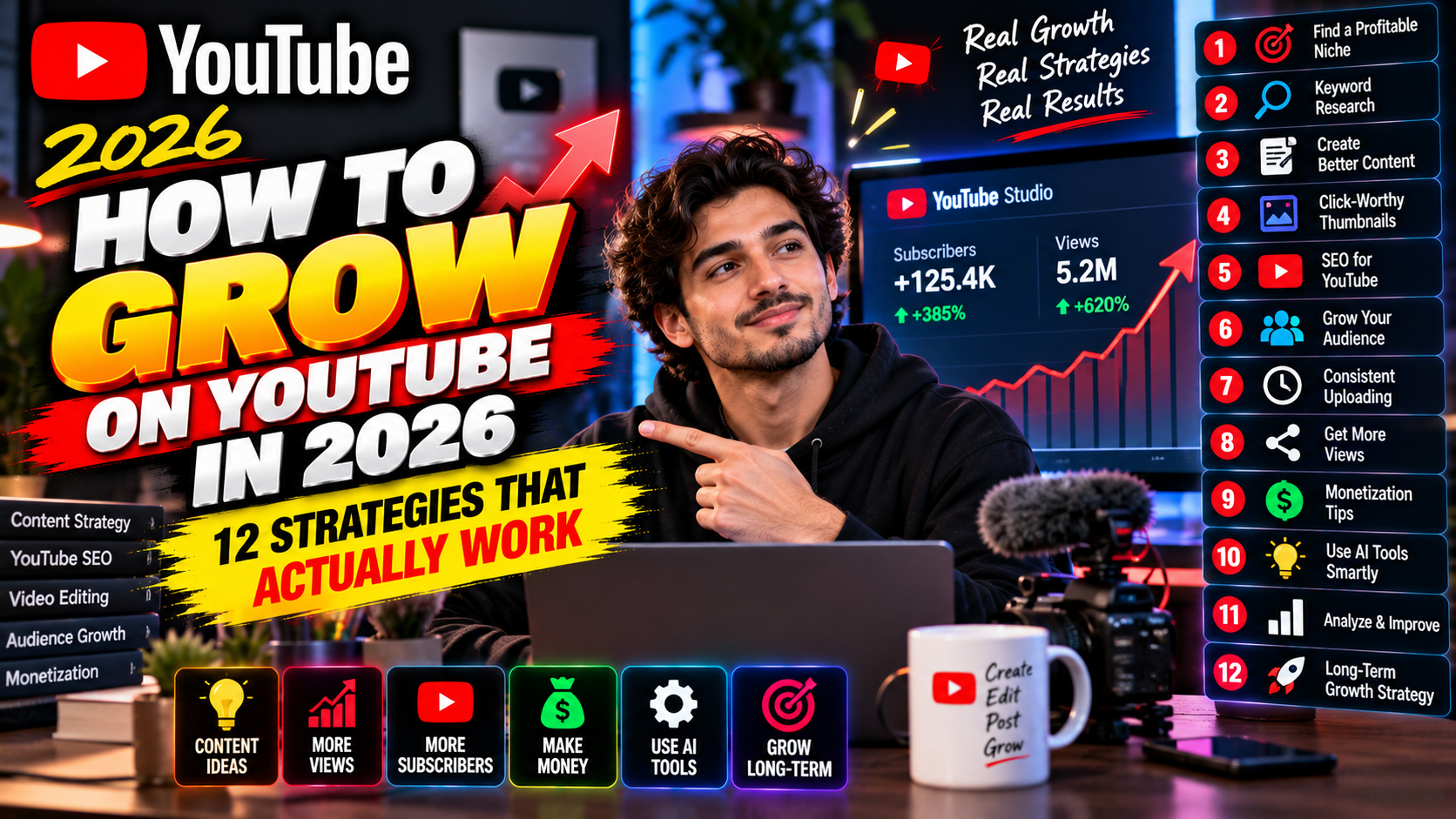
Everybody wants YouTube growth. Almost nobody wants to hear that it’s a system, not a lottery ticket. But after watching hundreds of channels grow — and hundreds more stall — the pattern is hard to argue with: channels that grow in 2026 do specific things, consistently. Channels that don’t, don’t. No hacks below. No sub-for-sub. No “post at 3:33 PM on Tuesdays” nonsense. Just the 12 strategies that actually move the needle, whether you’re starting from zero or stuck on a plateau. No channel yet? YouTube lets you set one up free in minutes — do that first, then come back and work this list.
1. Pick a Lane (Then Own It)
The algorithm needs to know who to recommend you to. Viewers need to know why they should subscribe. “I post whatever I feel like” is a fine hobby — it’s not a growth strategy. Your lane can be broad (tech, cooking, finance), but it has to be legible: a new visitor should get your channel in about five seconds. Here’s the test — can you describe your channel in one sentence that makes a specific person think “that’s for me”? If not, narrow it down. You can always expand later. Every big creator you admire started narrow.
2. Titles and Thumbnails Are 80% of the Battle
Uncomfortable truth: your video’s quality barely matters if nobody clicks on it. And the click comes down to two things working as a team — title and thumbnail. Some rules that actually work: the thumbnail and title should complement each other, not repeat each other. If the thumbnail shows the result, the title should tease the process. Faces showing strong emotion outperform almost everything in most niches. Thumbnail text: three words max, readable on a phone screen. And curiosity gaps beat clickbait every time — “I Tried X for 30 Days” promises a story; “You Won’t BELIEVE This!!!” promises nothing. Spend as long on the thumbnail as you spend on the edit. I’m serious.
3. Hook in the First 15 Seconds
YouTube measures everything, but the earliest signal is what happens in the first 30 seconds. So open with the payoff, not the preamble. The bad version: “Hey guys, welcome back to the channel, don’t forget to like and subscribe, today we’re going to talk about…” — viewer already gone. The good version: start mid-action, state the promise, deliver. “This $30 gadget saved me 5 hours this week — here’s how.” The subscribe begging, the channel intro, the pleasantries? All of that comes after you’ve earned the viewer’s attention. Never before.
4. Optimize for Watch Time, Not Views
A video with 10,000 views and 60% average retention will beat a video with 100,000 views and 15% retention — because YouTube promotes whatever keeps people on the platform. So how do you hold attention? Cut ruthlessly (every boring second is a reason to leave). Use pattern interrupts — change the visual every 5 to 10 seconds with b-roll, zooms, or graphics. Structure with open loops: “I’ll show you the mistake that cost me $500 — but first…” Then study your retention graphs in YouTube Studio like they owe you money. The exact second viewers leave is the most valuable feedback you’ll ever get. Fix that second in your next video.
5. Post Consistently (Sustainably)
The algorithm rewards consistency. Burnout kills channels. The answer isn’t “post daily” — it’s “post on a schedule you can keep up for two years.” For most humans, that’s one solid video a week. One excellent video every week beats five mediocre ones, and it beats the one monthly epic that took so long you quit. Batch your work: film two videos in a day, edit across the week. And say the schedule out loud — “new videos every Tuesday” sets an expectation that builds habit viewership.
6. Use Shorts as a Discovery Engine
In 2026, YouTube Shorts are the fastest discovery mechanism on the platform. But treat them as trailers, not the main feature. The formula that works: post Shorts built from your long-form content — the most surprising 30 seconds of your full video, ending with “full video on my channel.” Shorts viewers convert to subscribers at lower rates than long-form viewers, but the raw volume makes up for it. Just don’t build a Shorts-only channel unless you’re fine never getting long-form watch time. The two audiences behave very differently.
7. Master YouTube SEO (It’s Still Free Traffic)
YouTube is the world’s second-biggest search engine, and search traffic compounds forever — a well-optimized video from 2024 still pulls daily views. The fundamentals: work your exact target keyword into the title naturally (“How to Clean Install Windows 11,” not “Windows Shenanigans Episode 47”). Write a 200+ word description with keywords in the first two sentences. Add relevant tags — they matter less than they used to, but they still help. And say the keyword out loud in the first 30 seconds, because YouTube transcribes everything. For the current official guidance (it changes), check YouTube’s official Help center.
8. Study Your Analytics Like a Scientist
YouTube Studio tells you exactly what’s working. Most creators just never look. Three metrics actually matter: click-through rate (are your titles and thumbnails doing their job?), average view duration (is the content holding people?), and traffic sources (where are viewers even coming from?). When a video overperforms, take it apart — why did it work? Do more of that. When one flops, find where retention fell off a cliff and fix that specific thing. Growing channels treat every upload as an experiment with data attached. Stalled channels treat analytics like a report card to feel bad about.
9. Engage Your Early Community Personally
When you’re small, you have one unfair advantage: intimacy. Reply to every comment. Heart the good ones. Ask questions in your videos — and actually respond to the answers. A viewer who gets a reply turns into a loyalist, and loyalists become the core audience that watches everything, which is exactly what the algorithm notices. This doesn’t scale, and that’s precisely the point. Do it now while you still can, because the personal connection you build at 100 subscribers is what carries you to 10,000. Big channels can’t do this anymore. You can.
10. Collaborate Sideways, Not Up
Everyone dreams of collaborating with bigger creators. Almost nobody gets to. Here’s the growth move nobody talks about: collaborate with creators at your own level. Two channels at 1,000 subscribers cross-pollinating audiences — that’s how both get to 5,000. Look for creators in adjacent niches (not identical ones — you want audience overlap, not a duplicate audience), pitch something genuinely fun, and split the work evenly. One good collaboration can outperform a month of solo uploads. I’ve seen it happen repeatedly.
11. Repurpose Everything
One long video should become at least five things: 3 Shorts (the best moments), 1 community post (behind the scenes), 5 short posts (the key takeaways), and 1 blog post (the full guide in text form). This isn’t extra work — it’s squeezing full value out of work you already did. The creators growing fastest in 2026 aren’t necessarily making more content than you. They’re just distributing each piece across more surfaces. The YouTube video is the asset. Everything else is distribution.
12. Play the Long Game (The Only Game)
Here’s what nobody selling a course will tell you: most channels need 6 to 12 months of steady posting before anything clicks. The algorithm needs data to figure out who likes you. You need reps to get good. Those creators who “blew up overnight”? Almost all of them have 50+ videos you never saw. So commit to 100 videos before you judge the channel. If that number scares you — good. That’s the filter. Most people quit at 12, which is exactly why the ones who reach 100 win. Start today, post weekly, check back in two years. Need help making the videos themselves? Our AI Tools section is a good place to start, and there are more growth guides in Tutorials.
Related Reading
Keep exploring: How to Create a YouTube Channel in 2026, How to Use Instagram Reels to Grow in 2026, and How to Edit TikTok Videos Like a Pro.