
OpenAI’s Quarterly Revenue Crosses $10 Billion — But Operating Losses Hit $10.9 Billion
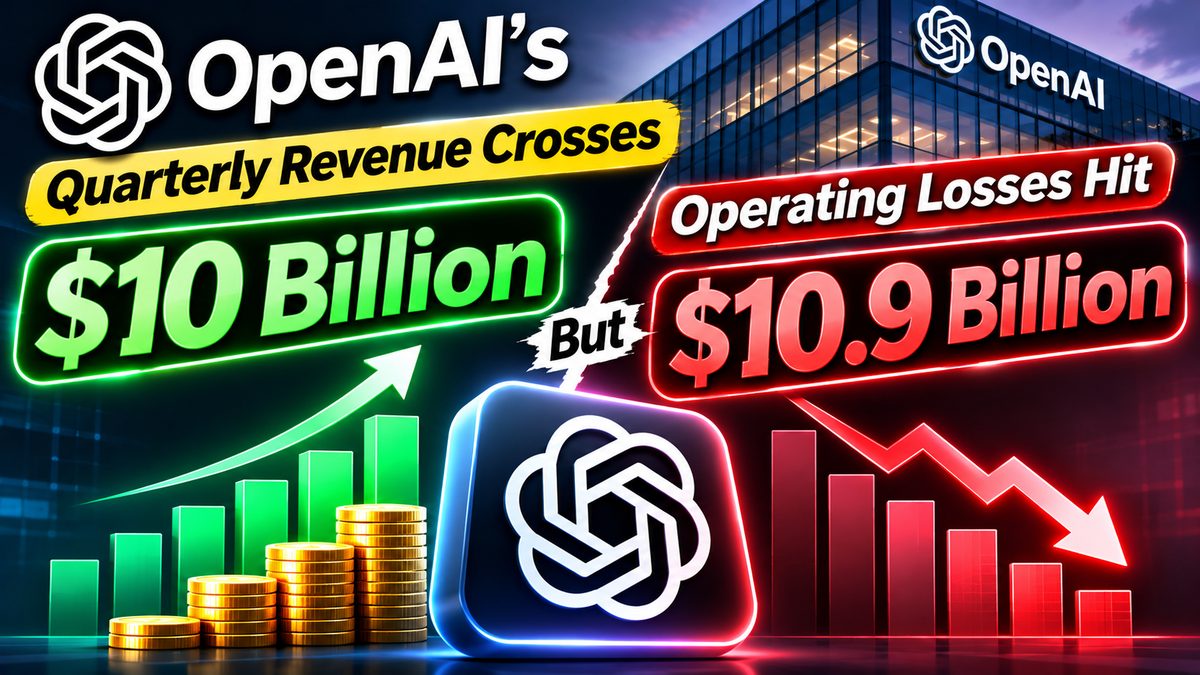
Ten billion dollars in a single quarter. That’s the number now attached to OpenAI, according to reports published on November 12, 2026 — a jump of roughly 50% in quarterly revenue, powered largely by enterprise sales. For a company that still isn’t public and doesn’t file audited accounts for the world to read, it’s a striking figure.
Then there’s the second number, and honestly it’s the one I keep coming back to: operating losses of about $10.9 billion in the same period. Read those two figures side by side. OpenAI reportedly took in more money in three months than most tech companies see in years — and spent even more than that just keeping the operation running. How long can a business grow like this? That’s the question hanging over the whole AI industry right now.
A $10 Billion Quarter — Reported, Not Filed
First, a word of caution about where these numbers come from. OpenAI hasn’t published them in an official filing, and it hasn’t confirmed them in a press release. The figures surfaced through news reporting — daily industry roundups such as The Neuron’s November 12 digest carried the story — and they describe what the company is reported to have achieved, not what an auditor has signed off on.
That distinction matters. Private companies can choose what to share and when to share it, and the numbers that reach journalists often come through investor channels rather than formal disclosures. So treat the $10 billion as reported revenue: widely circulated, consistent across the coverage, but not confirmed by OpenAI itself.
Even with that caveat, the direction of travel is hard to argue with. A quarterly revenue jump of around 50% doesn’t happen by accident, and it doesn’t happen on consumer subscriptions alone. Something structural is driving this — and the reporting points squarely at businesses.
Enterprise Sales Did the Heavy Lifting
According to the reports, enterprise sales were the engine behind the quarter. That tracks with what OpenAI has been saying publicly for a while: companies aren’t just experimenting anymore, they’re signing contracts, rolling tools out to whole departments, and paying for it. OpenAI’s own site recently highlighted that more than 1 million business customers now pay to use its products, through ChatGPT for Work or directly through its developer platform.
Why does the enterprise angle matter so much? Because business contracts are steadier than consumer subscriptions. A curious user can cancel a monthly plan on a whim. A company that has wired a model into its support desk, its sales pipeline, or its software workflow doesn’t walk away so easily — and it tends to spend more over time, not less.
There’s a flywheel here, too. Hundreds of millions of people already know ChatGPT from their personal lives, so when their employer rolls it out at work, there’s barely any training curve. Familiarity at home becomes adoption at the office, and adoption at the office becomes the kind of revenue growth these reports describe.
OpenAI has been raising money at a pace that matches this ambition — we covered its reported $1.25 trillion funding round earlier this month — and quarters like this one are exactly what investors are paying for. Growth first. The bill comes later. Except, well, the bill is already here.
The Other Number: $10.9 Billion in Operating Losses
Let’s sit with that loss figure for a moment. $10.9 billion in operating losses against a reported $10 billion or so in revenue means that, on paper, OpenAI spent more than two dollars for every dollar that came in once you count the full weight of running the business. The reports pin the blame mainly on training costs — the enormous computing bills that come with building ever-larger frontier models.
Training a top-tier model isn’t like spinning up a website. It means vast clusters of specialised chips running for weeks or months, drawing power like a small city, staffed by some of the most expensive engineers on the planet. Every generation of model costs more to build than the one before it, because the expectations keep rising: bigger, smarter, faster, safer.
And OpenAI can’t simply slow down. Anthropic, Google, Meta and a pack of well-funded rivals are all racing toward the same finish line, and falling a generation behind can mean losing the enterprise customers who just started paying. We saw that pressure play out only days ago in the split launch of Claude Fable 5.2 and the restricted Mythos 5.2 — capability is the product, and capability is bought with compute.
So the losses aren’t a sign that nobody wants what OpenAI sells. Demand, by every account, is booming. The losses are the price of staying at the front of the race while the race keeps getting more expensive.
What This Means for the AI Race
Here’s where I land on it. A reported $10 billion quarter proves the market is real — businesses are spending serious money on AI, and that spending is accelerating. That’s no small thing for an industry that, not long ago, was accused of running on hype.
But a reported $10.9 billion operating loss proves something else: the economics of frontier AI are still upside down. The company selling the most is also, apparently, losing the most. That can’t be the permanent shape of this industry. Either training costs come down, prices go up, the models get far more efficient to run — or some combination of all three has to give.
For now, investors seem content to fund the gap, and customers seem happy to keep buying. Both of those things can be true for a long time. They just can’t be true forever. The next few quarters will tell us whether that loss line starts bending toward the revenue line — or whether the gap becomes the story instead of the growth.