
How to Use AI for Research Without Getting Fooled
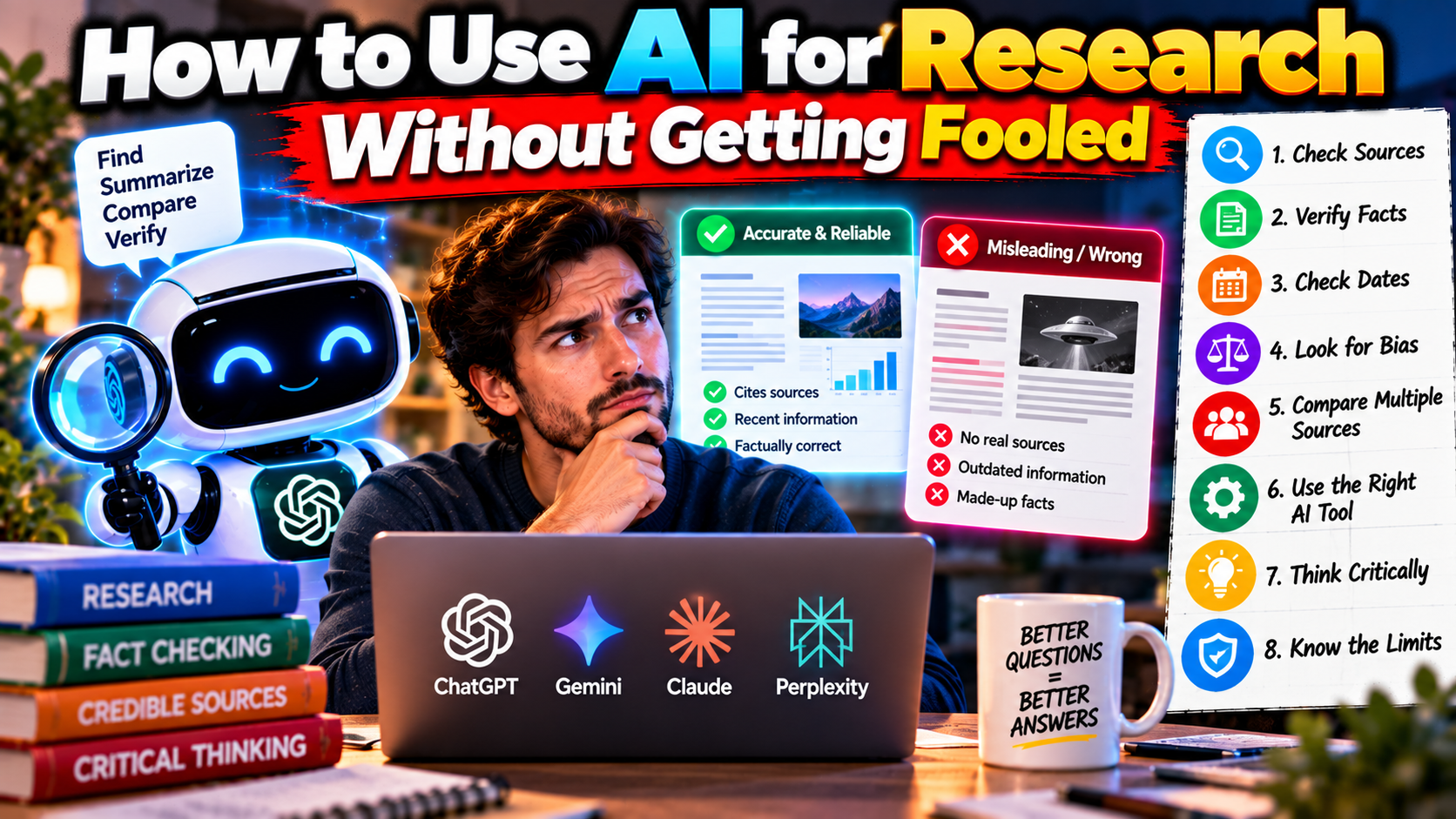
AI will happily write you a beautiful, detailed, completely fictional research summary — complete with fake citations to papers that don’t exist. It happens all the time, to careful people. AI makes research ten times faster and ten times easier to get wrong. Here’s how to use it safely: fast where it’s safe, paranoid where it matters.
Rule 1: AI Explores, Sources Decide
The golden rule: use AI to map the territory, never as the territory. “Give me an overview of this topic and the key debates” — great use. “Tell me the exact statistics” — dangerous use. AI is a brilliant research assistant for orientation and a terrible one for facts. Every number, quote, and claim that matters must be verified against a primary source. No exceptions, no matter how confident the answer sounds.
The Tools That Actually Help
Perplexity: the AI search engine that cites sources inline. A solid starting point for any topic — ask a question, get an answer with links, then actually open the links. The citations are the feature; the answer is the appetizer.
NotebookLM: Google’s research tool where YOU provide the sources (upload papers, docs, links) and the AI only answers from them. This flips the hallucination problem — it can’t invent facts because it can only quote your documents. For serious research on a defined corpus, nothing else comes close.
ChatGPT/Claude with browsing: good for brainstorming angles and finding search terms you hadn’t thought of. “What do experts disagree about on this topic?” is a fantastic prompt — then go read the actual experts. Use it to find the debate, not to settle it.
The Hallucination Red Flags
Watch for these tells that AI is inventing: suspiciously round numbers, citations you can’t find on Google Scholar, quotes that sound perfect (real quotes are messier), “studies show” without naming the study, and confident answers to questions where experts genuinely disagree. When AI is unsure, it doesn’t say so — it performs certainty. Your job is to be the skeptic it isn’t. If a claim feels too neat, that’s your cue to dig.
My Research Workflow
Here’s a process that holds up: (1) Perplexity for the landscape and key sources. (2) Open the 3-5 best sources and skim them yourself. (3) Upload the important ones to NotebookLM for deep Q&A. (4) Use ChatGPT to stress-test your conclusions — “argue against my thesis.” (5) Write from the sources, not from the AI summaries. Total time: about a third of the old way, with better coverage. The key discipline is step 5 — the moment you start writing from AI summaries instead of sources, the verification chain breaks.
What About Academic Work?
Students and researchers: check your institution’s AI policy first — they vary wildly, and “I didn’t know” isn’t a defense. The safe pattern everywhere: AI for brainstorming, outlining, and understanding; your own words and verified sources for the actual work. Disclose AI assistance where required. And never, ever let AI generate your bibliography — fabricated citations are the fastest way to torch your credibility. Professors check; they always check.
The Bottom Line
AI is the best research assistant in history and the worst source in history — simultaneously. Use it for speed, trust only what you verify, and keep the critical thinking switched on. The researchers who thrive won’t be the ones who avoid AI or the ones who trust it blindly, but the ones who learned to interrogate it. Keep a simple habit: for every AI-assisted claim that matters, save the primary source link alongside it. Future-you (or your editor, teacher, or client) will want to see where it came from. Research you can’t source is trivia; research you can source is knowledge. Build the habit now and it’ll pay off in every project, paper, and post you ever write. More research tools in AI tools and methods in tutorials.
Related Reading
Keep exploring: How to Write Better ChatGPT Prompts: 7 Techniques That Actually Work, 7 Ways Students Use AI to Study Smarter (Without Cheating), and ChatGPT vs Claude vs Gemini: Which AI Should You Actually Pay For?.