
AI Tutors Tested: Can They Replace a Real Teacher?
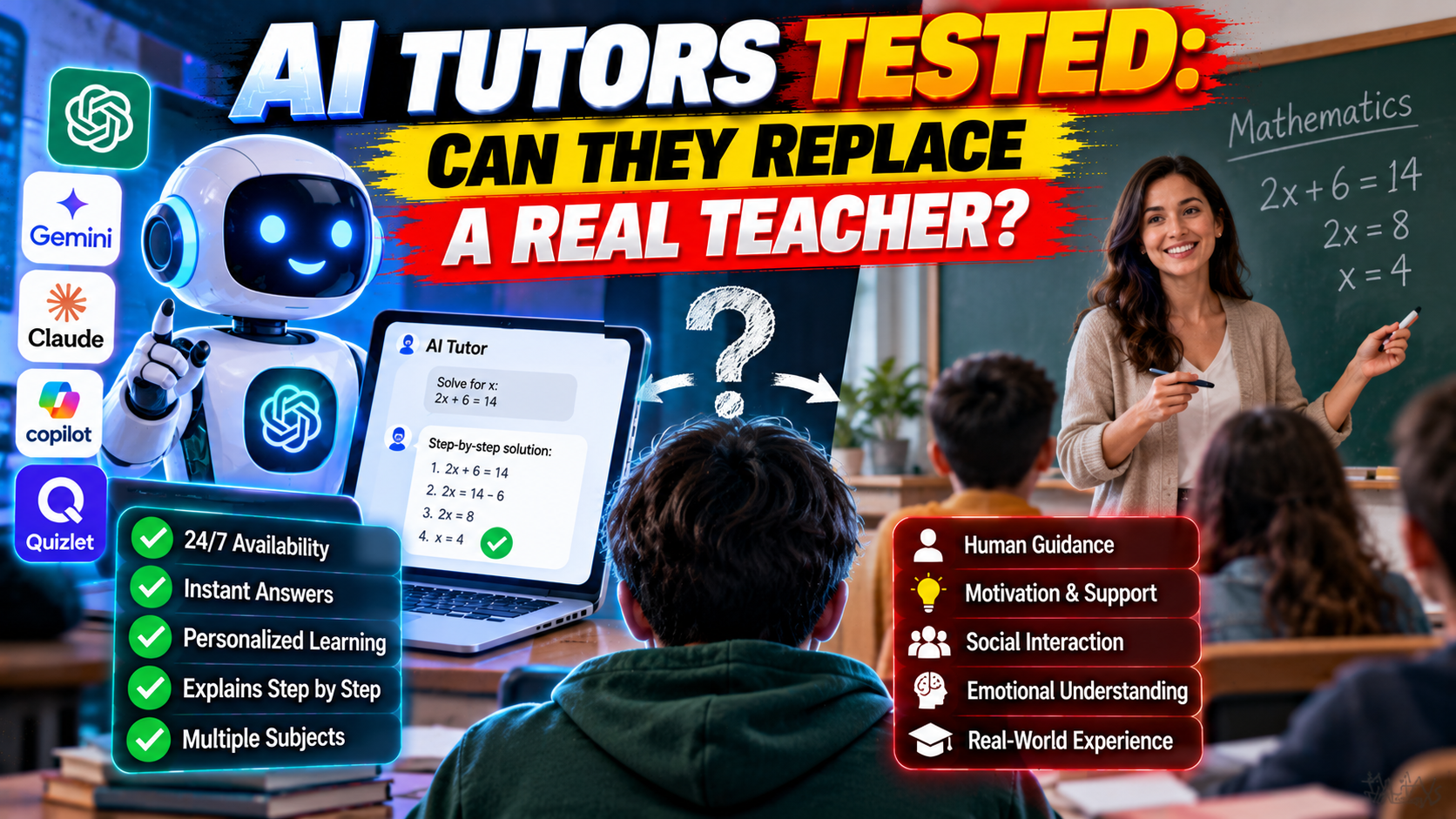
The pitch is seductive: a tutor with infinite patience, available at 2 AM, for free, in any subject. AI tutors are flooding education in 2026, and parents keep asking the same question: can they replace a real teacher? A structured comparison across math, languages, and science — answers cross-checked against answer keys, plus observation of how real students actually use these tools — gives an honest answer. Here’s what works, and where they fail.
What I Tested
Three setups: Khan Academy’s Khanmigo (the most “real tutor” of the bunch), general chatbots (Gemini and ChatGPT) prompted as Socratic tutors, and a couple of dedicated AI tutor apps. Subjects: algebra, basic Spanish, and high-school physics — chosen because the answers could be independently verified. That’s the only way to evaluate a tutor: check its work.
Where AI Tutors Are Genuinely Great
Infinite patience: the killer feature. An AI tutor will explain fractions seventeen different ways without a flicker of annoyance. For students who are embarrassed to ask “stupid” questions, this is transformative — and it’s the thing human tutors, however kind, can’t fully replicate.
Personalization at scale: the AI adjusts difficulty in real time, notices weakness on a sub-topic, and drills it. Good human tutors do this; great ones are expensive and rare. AI does a solid B+ version for everyone, at any hour.
Availability: homework at 11 PM, exam panic at 6 AM — the tutor is there. This alone justifies their existence. For families who could never afford private tutoring, this is genuinely democratizing.
Where They Fail
They can’t see you: a real teacher notices the confused face, the fidgeting, the “I say I understand but I don’t.” AI only sees your words. Students who are confidently wrong get confidently validated — the most dangerous failure mode in the bunch.
Motivation isn’t information: the hardest part of teaching isn’t explaining — it’s making someone care. AI can’t inspire, can’t share the joy of a subject, can’t be the teacher you remember 20 years later. Information transfer is maybe half of education; the rest is human.
Subtle errors: AI tutors are right roughly 95% of the time, which is worse than it sounds — the 5% is confident-sounding wrongness absorbed by a trusting student. Reviewers have caught physics explanations that were subtly, plausibly incorrect. A student working alone wouldn’t have.
How to Use AI Tutors Well
For students (or parents), here’s how to get the value without the pitfalls. Use the Socratic mode: ask the tutor to quiz you, not tell you — “don’t give me the answer, give me a hint.” Most tutor apps have this setting; turn it on. Verify the hard stuff: for anything graded or important, cross-check AI explanations against the textbook. Mix with humans: AI for daily practice, teacher or study group for the confusing 20%. Parents: sit in on the first few sessions — you’ll quickly see whether your kid is learning or answer-farming. The tool is neutral; the usage pattern is everything. A student who argues with the AI tutor learns more than one who copies from it — same as with any tutor, human or otherwise.
The Verdict: Tutor, Not Teacher
Can AI replace a tutor for homework help and practice? Increasingly, yes — and that’s genuinely good news for kids who can’t afford human tutors. Can it replace a teacher? No. Teaching is motivation, mentorship, noticing, caring — deeply human work that happens around the information, not in it.
The best model emerging: AI handles practice, drilling, and 2 AM questions; humans handle inspiration, mentorship, and the “why should I care.” Schools that frame it as replacement will get worse outcomes. Families that frame it as a tireless practice partner get a superpower. If you’re a student, our study guides pair well with an AI tutor — and there’s more in AI tools.
Related Reading
Keep exploring: 7 Ways Students Use AI to Study Smarter (Without Cheating), ChatGPT vs Claude vs Gemini: Which AI Should You Actually Pay For?, and How to Write Better ChatGPT Prompts: 7 Techniques That Actually Work.