
Google’s Big October: A Gemini Agent That Works While You Sleep, a New Fitbit, and Ad Changes
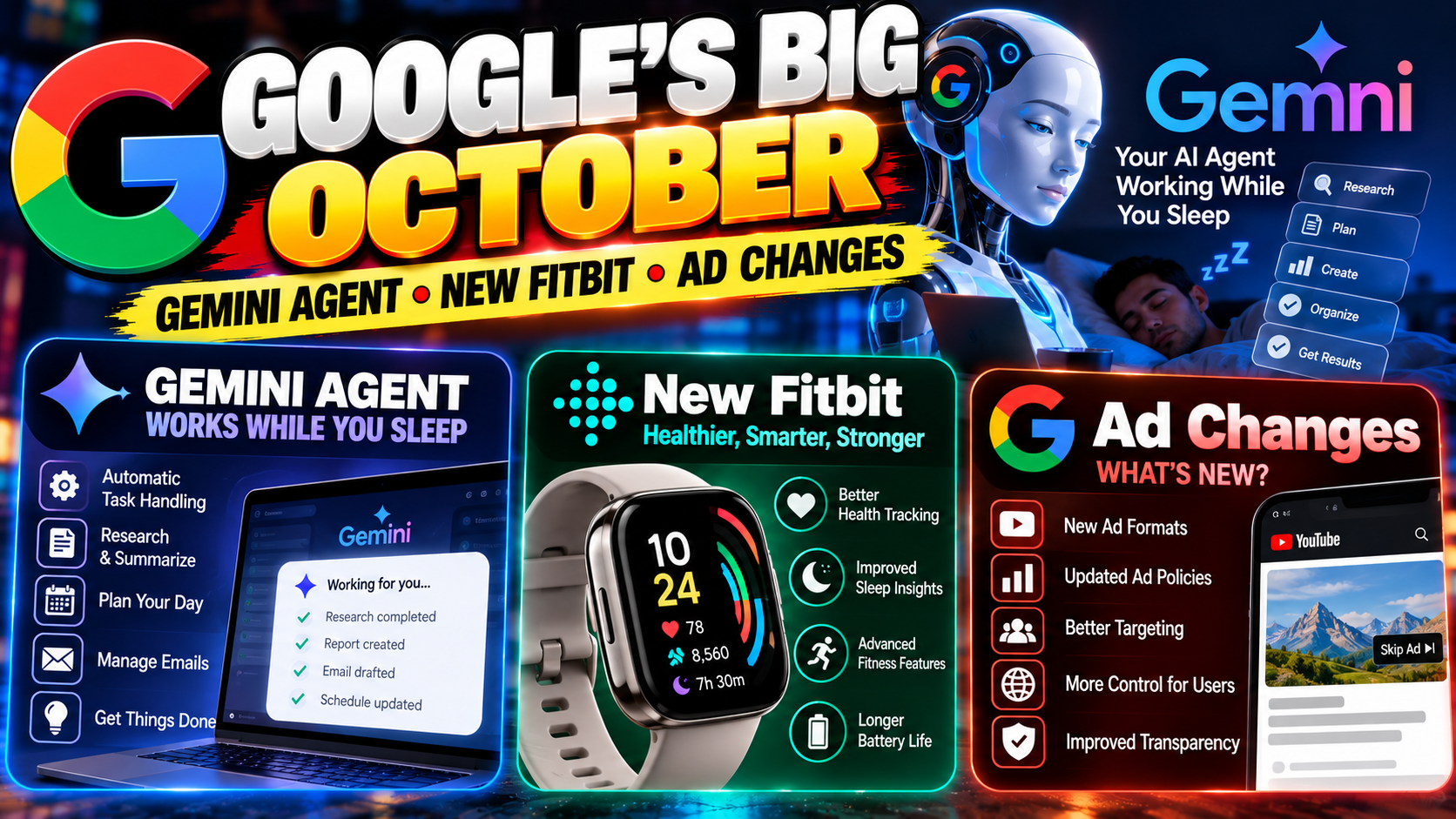
October usually belongs to Apple, but Google just made a strong case for sharing the spotlight. Within a few days, the company unveiled an autonomous AI agent that keeps working after you close your laptop, teased a brand-new Fitbit device, and quietly changed how Google Ads enrollments work. None of these is a Pixel launch — and that’s precisely what makes this week interesting. Google’s 2026 ambitions stretch way beyond phones.
The Gemini Agent: AI That Works the Night Shift
The biggest announcement landed at Gemini at Work 2026 on October 8, where Google Cloud introduced a universal “Gemini agent” — and “universal” is doing a lot of heavy lifting there. This isn’t a chatbot you talk to. It’s an autonomous agent with persistent memory and multi-agent coordination that keeps working in Google’s cloud after your laptop lid closes.
Think about what that actually means. Today you ask an AI a question, get an answer, session over. The Gemini agent model flips that: you hand it a goal — “research these three competitors and brief me Monday morning” — and it keeps grinding toward that goal in the cloud, coordinating sub-agents, remembering context across sessions, reporting back when it’s done. It’s the difference between hiring a consultant for an hour and hiring an employee.
Two details jump out. First, persistent memory: the agent remembers your preferences, past projects, working style, across sessions. Powerful — and, honestly, a bit unnerving. An AI that never forgets raises real privacy questions, and enterprise customers will quite rightly demand answers on data retention and isolation before rolling this out widely.
Second, the surprise: the agent can run Anthropic’s Claude models, not just Gemini. Google and Anthropic are competitors — Google’s also a major Anthropic investor — but baking model choice into Google’s own agent framework is a pragmatic admission: no single lab has the best model for every job. It’s also a shot across the bow at Microsoft and OpenAI’s more closed ecosystems. Private preview for now, so most of us will be watching from the sidelines while enterprise testers kick the tires.
Why Agents Are the Whole Ballgame Now
Zoom out and the pattern is hard to miss: Google’s agent, OpenAI’s always-on Dots, Anthropic’s cloud Cowork tasks — every major lab is converging on the same vision. The chatbot era, which felt revolutionary barely two years ago, is becoming the legacy interface. The future is AI that does work, not AI that answers questions.
This shift matters more than any single model upgrade. A slightly smarter chatbot is an incremental step. An AI that reliably executes multi-step tasks while you sleep? That’s a structural change in how work gets done. Whoever cracks agent reliability first wins the next platform shift — and “reliably” is doing enormous work in that sentence, because agents still make confident mistakes. Google’s entry, backed by its cloud infrastructure and Workspace integration, is a serious contender. The race is well and truly on.
Fitbit Edge: Google’s Wearable Tease
On hardware, Google teased a new Fitbit device expected to be called the Fitbit Edge, with a reveal set for October 12 — today, actually — under the tagline “Get an Edge on your health.” Details are thin by design. That’s what a tease is.
The context, though, is rich. Google’s wearable strategy has been… let’s call it evolving. The Fitbit brand survived the Google acquisition, the Pixel Watch became the premium wearable play, and Fitbit settled into the affordable fitness lane. A new “Edge” device suggests Google isn’t done reshaping the lineup. New form factor? A Charge-line rebrand? A more capable smartwatch under the Fitbit name? We’ll know soon — the reveal is literally today — but new Fitbit hardware in 2026 already answers the question some were asking about whether Google would quietly kill the brand. It won’t. Not yet, anyway.
And the wearable market in 2026 is genuinely fascinating: Apple owns premium smartwatches, Samsung owns Android premium, and the fitness-band lane — Fitbit’s home turf — is squeezed by cheap Chinese brands on one side and smart rings on the other. The Edge needs a clear reason to exist. “Get an Edge on your health” points at health sensing as the differentiator, which would be very Google: lead with sensors and AI health insights instead of apps and watch faces.
Google Ads: Automated Promotions Auto-Enrollment
The least glamorous announcement might hit the most businesses directly. Starting October 12, Google Ads begins automatic opt-in enrollment for eligible accounts into “Automated Promotions.” Plain English: Google will automatically create and run promotional offers in your ads unless you opt out.
For small advertisers, it’s a double-edged sword. Automated promotions can lift conversion rates — Google’s data presumably backs the rollout. But “automatic opt-in” is doing some very quiet work there. Plenty of small business owners don’t check their Ads accounts weekly, and discovering Google’s been auto-generating promotions with your budget is a nasty surprise. Run Google Ads? Check your account settings this week. Five minutes reviewing enrollment status could save you from paying for promotions you never approved.
It’s part of a broader pattern, too — platforms defaulting everyone into AI-driven automation. Meta does it, Google does it, and the house always wins when the default is “yes.” The savvy move never changes: review your defaults every quarter.
What Google’s October Tells Us
Put the three announcements side by side and a picture forms of Google in late 2026: an AI infrastructure company that happens to make phones, not a phone company dabbling in AI. The Gemini agent is a cloud play. The Fitbit tease is a health-data play. The Ads change is a monetization-automation play. The thread connecting them is AI applied to everything Google touches — which, at this point, is nearly everything digital.
The open question is execution. Google’s history is full of brilliant announcements that withered from neglect (RIP to more products than I can count). The Gemini agent’s private preview has to become a real product. The Fitbit Edge has to find its lane. Advertisers have to trust the automation. Announcements are cheap; follow-through is everything. We’ll be watching. For more Google and AI coverage, see our Tech News and AI Tools sections.
Related Reading
Keep exploring: 12 Best Free AI Tools in 2026 (No Credit Card Required) and Mobile News 2026: Latest smartphones, Foldable, AI & 5G Updates.