
LG Plans Home Humanoid Robots by 2030: What We Know
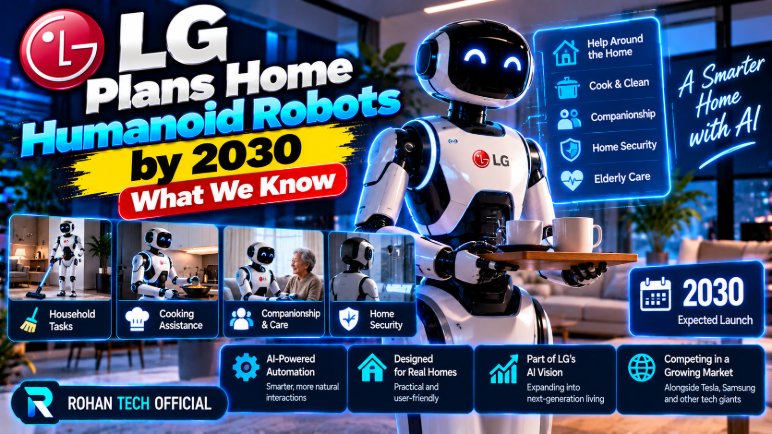
LG has put a date on the home humanoid dream. On its third-quarter earnings call this week, LG Electronics laid out a two-phase robotics plan: businesses first, your living room around 2030.
It’s one of the more concrete timelines any major company has offered for humanoid robots at home — and it tells you a lot about how LG thinks the technology will actually mature.
The two-phase plan
Phase one runs from now through roughly 2030 and is aimed squarely at business users: academia, public institutions, and manufacturing and logistics operations. That’s where LG’s humanoids will learn real work — handling materials, assisting in warehouses, and operating in controlled environments.
Phase two starts around 2030, when LG expects the home market to, in its words, “fully blossom.” That’s the telling phrase. LG doesn’t see the home humanoid as something you force into existence — it’s something that matures, once the technology, the use cases, and the price are all ready.
Pricing is a big part of that readiness. LG flagged consumer-accessible pricing as a key enabler of the home phase — the robot has to be something a household can actually buy, not a luxury demo.
Why businesses come first
The B2B-first approach is really about training data. LG has raised its robot training data target fivefold to 500,000 hours — an enormous corpus of real-world robot experience. Humanoids learn by doing, and factories and logistics floors are the gym where they’ll build up those hours before they ever see a living room.
There’s also a distinctly LG angle: robots and appliances designed for each other. LG’s vision has its humanoids working alongside — and with — its appliances, so a robot that understands the kitchen is working in a kitchen it was designed for. That interplay between the company’s appliance business and its robotics program is core to the strategy, according to coverage of the announcement on LG’s US newsroom.
What LG has already shown
The 2030 plan didn’t come out of nowhere. At CES 2026, LG showed off its CLOiD AI home robot under the company’s “Affectionate Intelligence” vision — a companion-style robot concept meant to feel less like a machine and more like a helper. The earnings call effectively turned that concept into a dated roadmap: the companion idea survives, but the home version waits for phase two.
More on the company’s broader direction is available through LG Corp’s official site, which tracks its robotics and AI initiatives across the group.
The competition and the reality check
LG isn’t alone in the humanoid race. Tesla’s Optimus, Figure’s robots, and a wave of Chinese manufacturers are all pushing toward similar goals — many of them promising sooner than 2030. LG’s timeline is, by comparison, refreshingly honest.
And honesty is warranted. A home humanoid has to be three things at once: safe around people, genuinely useful, and cheap enough to buy. The industry is still solving all three. LG’s phased plan reads as a bet that the B2B years will settle the safety and usefulness questions before the price has to come down for consumers.
What to watch next
Three things will tell you whether the 2030 date holds: whether the business deployments actually happen at scale, whether LG hits that 500,000-hour training target, and what the first home-oriented pricing looks like when it surfaces.
Until then, the smart-home battle stays where it is today — in hubs, glasses, and assistants. See our coverage of Apple’s HomeView smart home hub and Meta’s AI glasses from Connect 2026 for where the near-term action is.
2030 sounds far away, but in robotics, a dated plan beats a vague promise. LG just gave the industry one more data point for when the humanoid era actually starts at home.