
Nothing Teases Its First AI-Native Device: A Screen-Free Gadget Coming in December
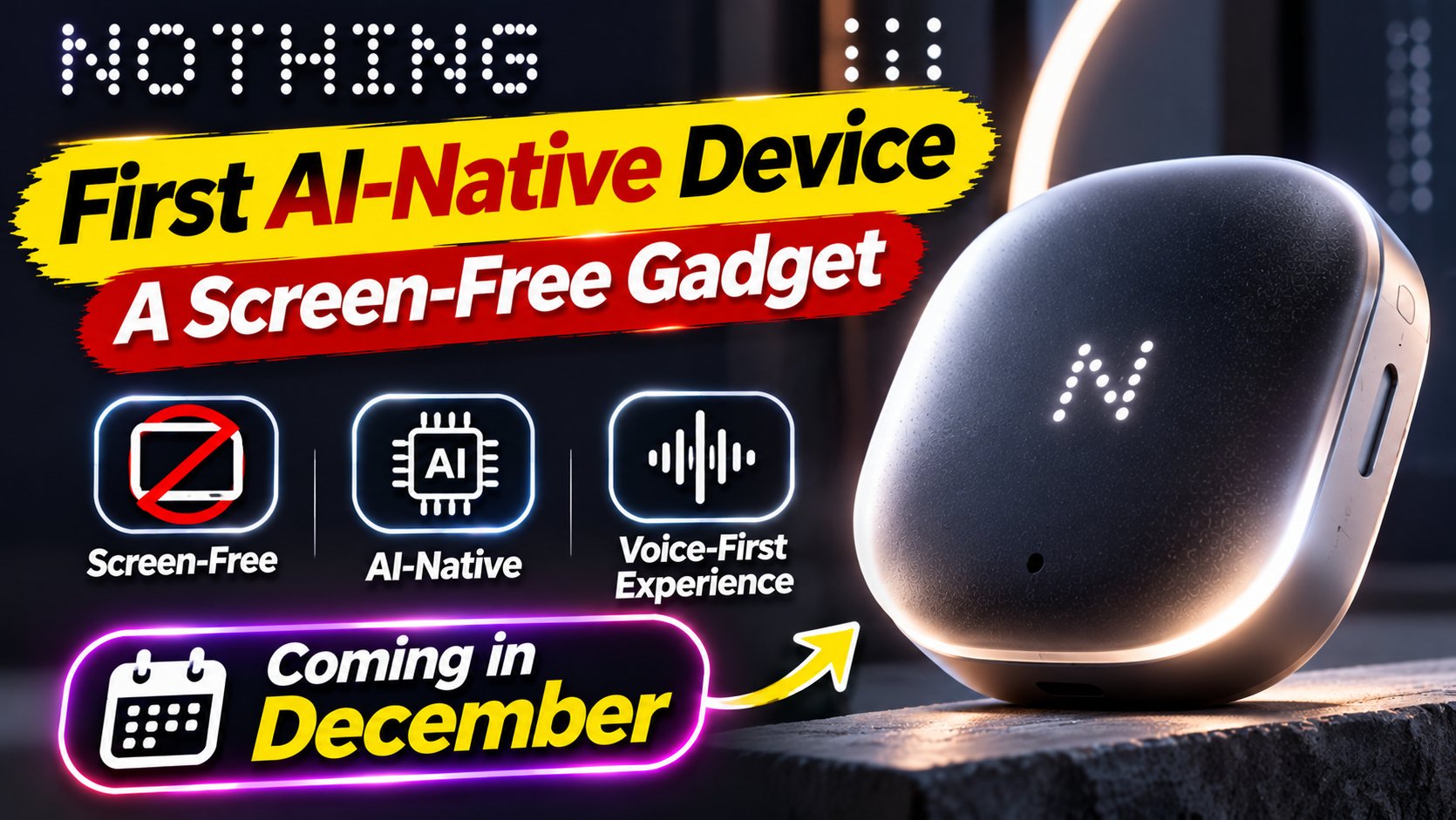
Nothing has spent ten years building phones that look like nothing else on the shelf. Now the London company wants to move past the phone itself. Founder Carl Pei said on X on Wednesday, November 5, that Nothing will launch its first AI-native device in December — a gadget with no screen at all.
Pei shared the news in a post on X, alongside an article on the company’s site that traces how personal tech has changed over the past decade. The message was short on specs and long on intent: after ten years of phones, Nothing thinks the next step is a device built around AI from the start, not a phone with AI bolted on.
What Pei actually said
“We’re excited to share our vision for the future of personal computing,” Pei wrote in the post, which pointed readers to the longer piece on Nothing’s site. The article argues that personal computing has moved in waves — from desktop computers to phones, then to personal data, and now to agents that can act on your behalf.
The new device, Pei says, is the next step in that chain. It is built to be “AI-native” and screen-free, which means it will rely on voice and other ways of talking to it rather than a display you tap and swipe. Nothing has not said what it looks like, what it costs or exactly when in December it arrives, but the company has promised more details closer to launch.
From phones to a device with no screen
The idea of a gadget with no screen will sound familiar to anyone who followed the AI hardware wave of the past two years. Devices like the Humane AI Pin and the Rabbit R1 tried a similar pitch and struggled to find buyers, largely because the software was not ready and the hardware could not do enough on its own.
Nothing is betting the timing is better now. AI models have got much stronger since those first attempts, and voice assistants can now hold a real conversation, remember context and carry out multi-step tasks. Pei’s argument is that the phone became the centre of our digital lives by accident — it was built for calls and texts, then swallowed everything else. A device designed for AI from day one, he suggests, could be simpler and more focused.
Whether buyers agree is another matter. A screen-free gadget has to earn its place in a pocket or on a desk next to a phone that already does almost everything. Nothing’s answer, so far, is that this device is not meant to replace the phone overnight. It is a first step toward a world where AI sits alongside the phone rather than inside it.
What December could bring
Nothing has kept the details close to its chest, but the timing tells us something. A December launch puts the device in front of buyers just as the holiday season peaks, and it gives Nothing a headline product to carry into 2027.
The company also has a track record of teasing products in stages — a cryptic post, then a name, then a design reveal — so expect more hints in the weeks before the launch. What we know for sure is that the device will be AI-native, screen-free and made by a company that has built its name on design. The rest, for now, is guesswork.
A busy 2027 on the cards
The AI device is not the only thing on Nothing’s roadmap. In the same week, Pei outlined plans for 2027 that include six or more phones, with a focus on fewer, better devices rather than a flood of models. The plan also includes a Phone (4a) in November, followed by the Phone (4) and the Headphone (a) later in the year.
It is a crowded schedule for a company that only launched its first flagship, the Phone (3), in July 2025 at $799, with its Glyph Matrix light display. Since then Nothing has also shipped the CMF Phone 2 Pro, the Phone (3a) and the Headphone (1), its first over-ear headphones.
The company has been growing fast behind the scenes too. Pei told CNBC in October that Nothing crossed 1,000 employees this year, is working toward a US headquarters and plans to open an AI hub in India. A report from TechCrunch in October said the company had raised $100 million in new funding to back that growth.
Why Nothing is betting on AI now
For Nothing, the AI device is a bet that the next ten years of personal tech will look very different from the last ten. Phones are mature, sales growth has slowed, and every major maker is now racing to put AI at the centre of its products. OpenAI is pushing AI into new formats too, with GIF creation and faster image editing in ChatGPT, while Apple is tightening what its own engineers can spend on AI tools.
Pei’s pitch is that a smaller company can move faster and take risks the giants will not. That has been Nothing’s story since it started — a phone with a clear back and a light strip was a risk once, too. This time the risk is bigger, and the prize is bigger as well: a place in the post-phone era, if that era really is coming.
Read the announcement on Nothing’s official site, Pei’s post on X, and the report on Gadgets 360.