
OpenAI’s Images 2.6 Brings GIF Creation and Faster Editing to ChatGPT
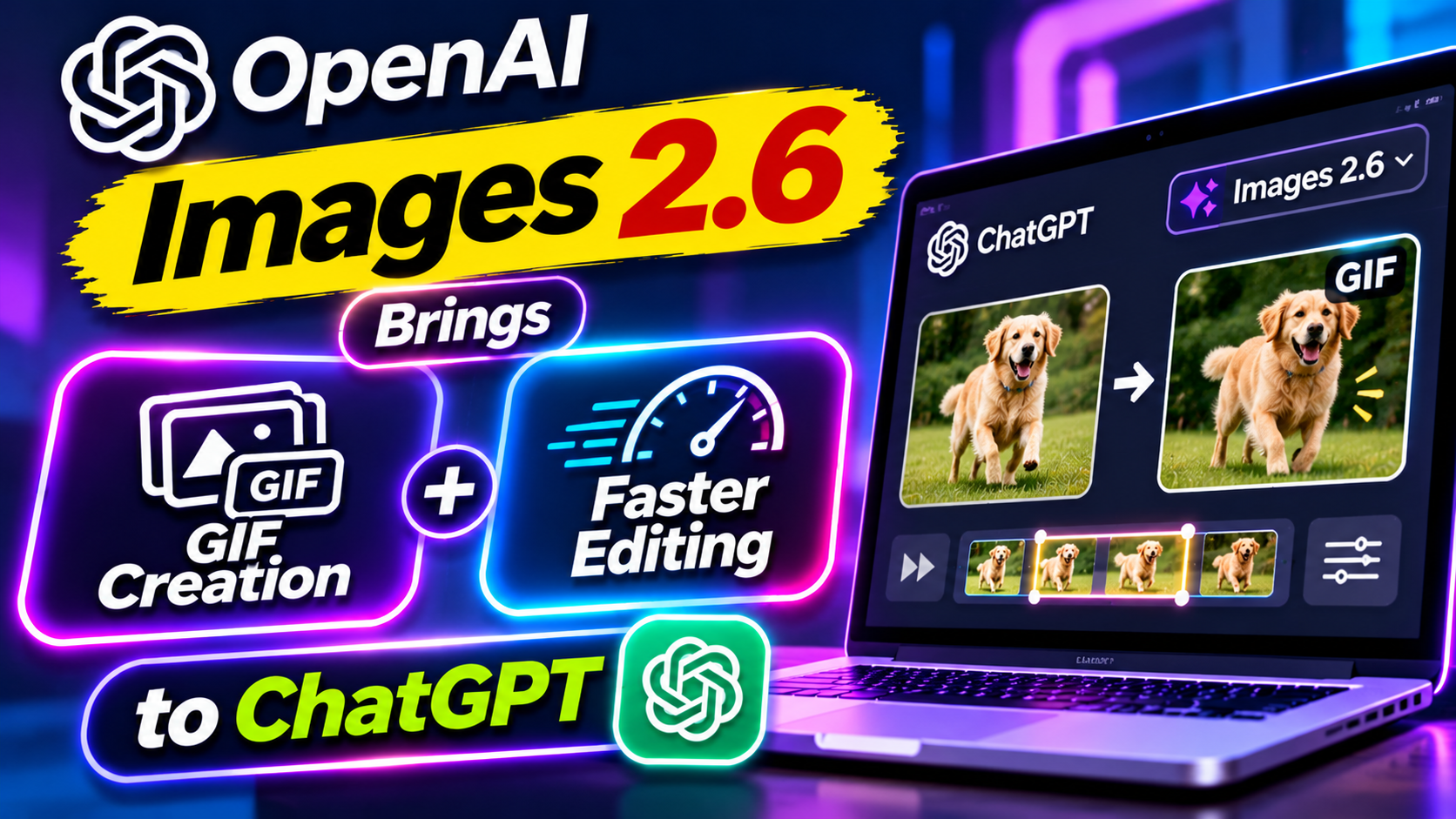
OpenAI has given ChatGPT’s image tools their biggest refresh in months, and the headline feature is one people have asked for since the first AI pictures went viral: proper GIFs. The company rolled out Images 2.6 on Wednesday, November 5, bringing GIF creation, sharper editing controls and faster models to both ChatGPT and its developer API.
The update is built on GPT Image 1.5, the model OpenAI released last month, and it touches almost every part of how images work in ChatGPT. If you make pictures, memes or product shots with the chatbot, the changes are hard to miss.
GIFs are the headline act
ChatGPT can now turn a still image into a short looping GIF, or build one from a text prompt on its own. The clips can run for up to 10 seconds, come out at 480p or 720p, and hit 50 frames per second, which is smooth enough for the kind of quick reaction clips people share in group chats.
That matters because GIFs are still one of the most shared formats on the web, and until now ChatGPT users had to take a still image somewhere else to animate it. Keeping the whole job inside one chat thread saves a step, and it makes the feature useful for social posts, birthday messages and quick jokes as much as for work.
Sora gets a piece of the same update too. GIFs made in the Sora app can now be shared straight to social feeds, so a clip you generate there does not have to stay locked inside the app.
Editing gets more room to play
The second half of the update is about control. Images 2.6 adds multi-image inpainting, which lets you pick parts of several pictures and blend them into one new image. You can feed in up to 16 images at once and get up to four versions back, so trying out ideas is much quicker than running the same prompt over and over.
Prompts can now point at up to three reference images at the same time, which helps when you want a character, a product or a style to stay steady across a set of pictures. Text inside images can be edited too, and pictures can now go up to 16 megapixels, or 4,096 by 4,096 pixels, with transparent PNGs supported for logos and cut-outs.
OpenAI has also added image search to the API, so developers can build tools that find pictures by what they show rather than by a file name. Put together, the editing changes feel aimed at people who use ChatGPT images for real work, not just for fun.
Faster models for developers
Behind the scenes, OpenAI has split its image model into two speed tiers. The full GPT Image 1.5 model is now about four times faster than the older GPT Image 1, and a new GPT Image 1.5 Mini is built for jobs where speed and cost matter more than top quality.
Existing GPT-4o and GPT-5 API users get the new models without changing their code, which should make the switch painless for apps that already call the image API. OpenAI says the faster models still keep the quality people expect from GPT Image 1.5, just with shorter waits.
What it costs
Prices have moved as well. GPT Image 1.5 now costs $0.01 per megapixel for image inputs and $0.02 per megapixel for outputs. The Mini version is much cheaper at $0.002 for inputs and $0.004 for outputs per megapixel, with cached inputs at $0.00125 per megapixel.
The older GPT Image 1 keeps its old pricing of $0.01 per megapixel in and $0.04 per megapixel out, so anyone with a workflow built on it does not face a surprise bill. For most casual users in ChatGPT, though, the price changes will stay invisible — they only bite when you generate images at scale through the API.
When you can try it
Images 2.6 is live now for ChatGPT paid plans and through the API, and OpenAI says free users will get it shortly. In India, the rollout is set to reach users by November 10, according to the company’s notes.
That timing fits a pattern: OpenAI has been shipping image updates fast since GPT Image 1.5 arrived, and each one has pushed the tools a little further from novelty and a little closer to something you would reach for at work. GIFs are the fun part of this release, but the editing and speed gains are the parts that will stick around. OpenAI is also reshaping how it talks about its data centres, and the company recently folded ChatGPT and Codex into one shared plan.
Read more in the official announcement from OpenAI, the image model docs at OpenAI’s platform, and the report on Gadgets 360.