
Power Banks Explained: How to Pick the Right One
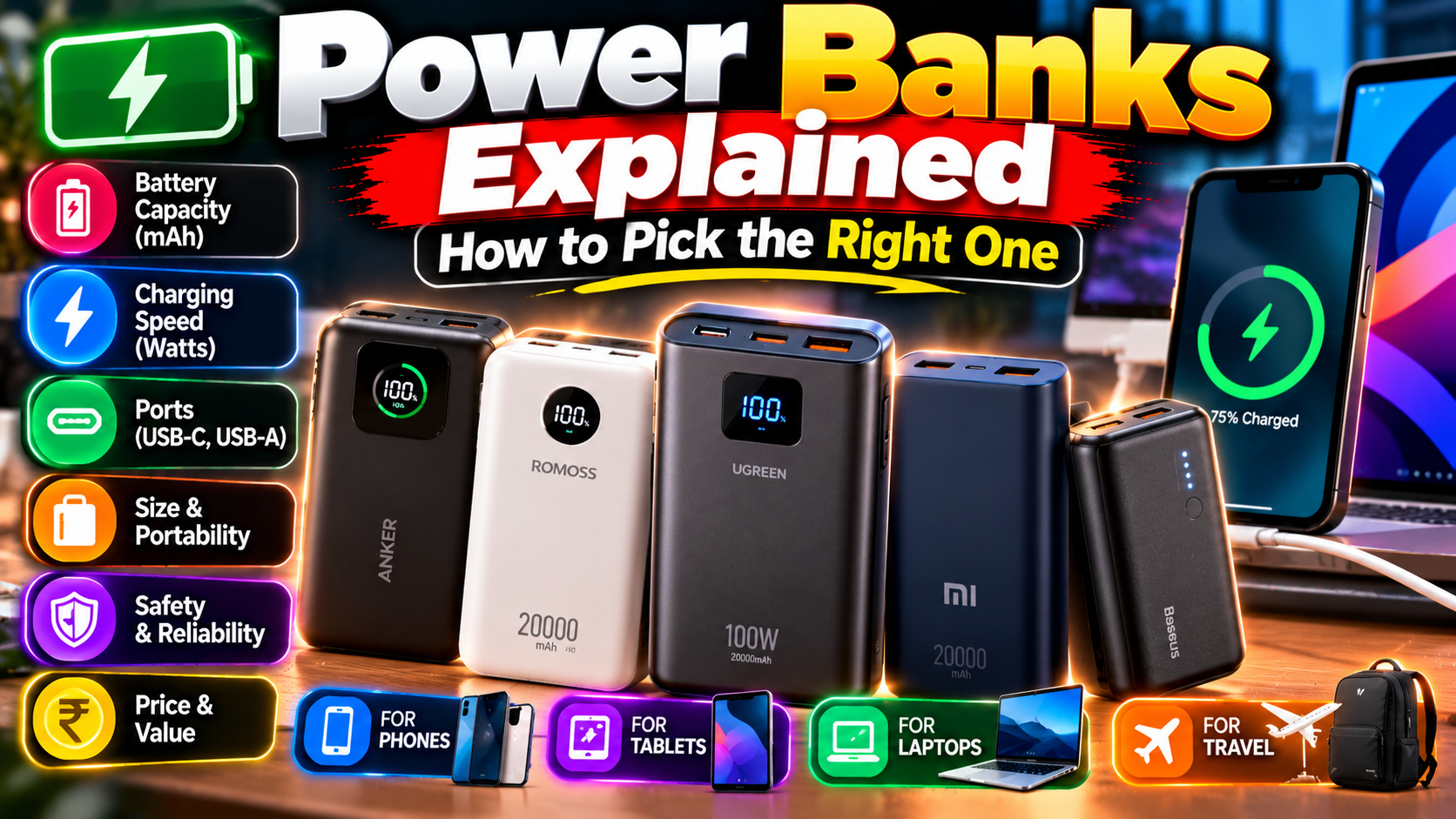
Power bank shopping feels like it requires an engineering degree. Milliamp-hours, wattage, PD, PPS, pass-through charging — sellers throw numbers around hoping you’ll just grab the biggest mAh at the lowest price. Don’t. Here’s how to pick a power bank in plain English, plus the tricks sellers use that you should know about.
mAh Is a Lie (Sort Of)
That big “20000mAh” number on the box? It’s the capacity of the internal battery cells at 3.7 volts — but your phone charges at 5 volts, and conversion loses energy along the way. Real-world rule of thumb: multiply the advertised mAh by 0.6 to get usable phone-charging capacity. So a “10000mAh” bank actually delivers about 6000mAh to your phone — roughly 1.5 charges for a typical modern phone, not the “2–3 charges” the listing claims.
Translation for normal humans: 10000mAh covers a day trip (1–1.5 phone charges). 20000mAh handles weekend travel (3+ charges) but you’ll feel the weight. Above 20000mAh, you’re charging laptops or sharing with friends. Match the size to your actual need — bigger isn’t better if it lives in your drawer because it’s too heavy to carry.
Wattage Matters More Than Capacity
A huge power bank that charges slowly is just a heavy paperweight. Check two numbers before anything else: output wattage (how fast it charges your device) and input wattage (how fast the bank itself recharges). For phones, 18–22W output is the sweet spot. For laptops, you want 45W minimum, ideally 65W. And input matters enormously — a 20000mAh bank with slow 10W input takes 8+ hours to refill; with 30W+ input it’s done in two or three.
Look for “PD” (Power Delivery) on the spec sheet — it’s the universal fast-charging standard that works across brands. Anker and Belkin both publish honest specs, so use their listings as a reference for what real numbers look like.
The Features Worth Paying For
Built-in cables: sounds gimmicky, genuinely life-changing. The number one reason power banks go unused is a forgotten cable. Digital display: an exact percentage beats four vague LED dots. Pass-through charging: charge the bank and your phone from one wall plug overnight — one cable, zero juggling. Airline-safe capacity: stay under 100Wh (about 27000mAh) or airlines get grumpy at security.
Tricks Sellers Use
Seen a “54000mAh” bank the size of a phone? Physically impossible — that’s either a lie or a fire hazard. No-name brands with zero reviews? The cells inside are the cheapest available and degrade within months. And “solar charging” power banks? The panel is far too small to meaningfully charge anything — it’s decoration, not a feature. Buy from established brands, check that the weight makes sense for the capacity (a real 20000mAh bank weighs roughly 350–450g), and get suspicious of anything dramatically cheaper than the competition. There’s always a reason.
My Recommendation
For most people, the answer is simple: a 10000mAh bank, 22W+ PD output, built-in USB-C cable, from a known brand, costing about the price of two pizzas. It’ll live in your bag, actually get used, and save you at airports, weddings, and load-shedding evenings alike. Keep your phone’s own battery healthy too with our battery-saving guide, and find more honest buying advice in gadgets.
Charging Your Power Bank Right
One thing nobody mentions: how you charge the bank affects how long it lasts. Use a decent wall charger — not a laptop USB port trickling 5W overnight — and avoid leaving the bank plugged in for days after it’s full. Modern ones stop charging automatically, but heat is still the enemy of battery chemistry. Also, lithium batteries hate sitting at 0% or 100% for months. Storing a power bank long-term? Leave it around half charge. And if your bank ever swells, gets hot for no reason, or smells sweet or chemical — stop using it immediately and recycle it properly. A damaged lithium battery isn’t a “maybe later” problem. Treat these with the same respect you’d give any dense energy storage, because that’s exactly what they are. Power bank shopping feels like it requires an engineering degree. Milliamp-hours, wattage, PD, PPS, pass-through charging — sellers throw numbers around hoping you’ll just grab the biggest mAh at the lowest price. Don’t. Here’s how to pick a power bank in plain English, plus the tricks sellers use that you should know about. Power bank shopping feels like it requires an engineering degree. Milliamp-hours, wattage, PD, PPS, pass-through charging — sellers throw numbers around hoping you’ll just grab the biggest mAh at the lowest price. Don’t. Here’s how to pick a power bank in plain English, plus the tricks sellers use that you should know about.
mAh Is a Lie (Sort Of)
That big “20000mAh” number on the box? It’s the capacity of the internal battery cells at 3.7 volts — but your phone charges at 5 volts, and conversion loses energy along the way. Real-world rule of thumb: multiply the advertised mAh by 0.6 to get usable phone-charging capacity. So a “10000mAh” bank actually delivers about 6000mAh to your phone — roughly 1.5 charges for a typical modern phone, not the “2–3 charges” the listing claims. That big “20000mAh” number on the box? It’s the capacity of the internal battery cells at 3.7 volts — but your phone charges at 5 volts, and conversion loses energy along the way. Real-world rule of thumb: multiply the advertised mAh by 0.6 to get usable phone-charging capacity. So a “10000mAh” bank actually delivers about 6000mAh to your phone — roughly 1.5 charges for a typical modern phone, not the “2–3 charges” the listing claims. Translation for normal humans: 10000mAh covers a day trip (1–1.5 phone charges). 20000mAh handles weekend travel (3+ charges) but you’ll feel the weight. Above 20000mAh, you’re charging laptops or sharing with friends. Match the size to your actual need — bigger isn’t better if it lives in your drawer because it’s too heavy to carry. Translation for normal humans: 10000mAh covers a day trip (1–1.5 phone charges). 20000mAh handles weekend travel (3+ charges) but you’ll feel the weight. Above 20000mAh, you’re charging laptops or sharing with friends. Match the size to your actual need — bigger isn’t better if it lives in your drawer because it’s too heavy to carry.
Wattage Matters More Than Capacity
A huge power bank that charges slowly is just a heavy paperweight. Check two numbers before anything else: output wattage (how fast it charges your device) and input wattage (how fast the bank itself recharges). For phones, 18–22W output is the sweet spot. For laptops, you want 45W minimum, ideally 65W. And input matters enormously — a 20000mAh bank with slow 10W input takes 8+ hours to refill; with 30W+ input it’s done in two or three. A huge power bank that charges slowly is just a heavy paperweight. Check two numbers before anything else: output wattage (how fast it charges your device) and input wattage (how fast the bank itself recharges). For phones, 18–22W output is the sweet spot. For laptops, you want 45W minimum, ideally 65W. And input matters enormously — a 20000mAh bank with slow 10W input takes 8+ hours to refill; with 30W+ input it’s done in two or three. Look for “PD” (Power Delivery) on the spec sheet — it’s the universal fast-charging standard that works across brands. Anker and Belkin both publish honest specs, so use their listings as a reference for what real numbers look like. Look for “PD” (Power Delivery) on the spec sheet — it’s the universal fast-charging standard that works across brands. Anker and Belkin both publish honest specs, so use their listings as a reference for what real numbers look like.
The Features Worth Paying For
Built-in cables: sounds gimmicky, genuinely life-changing. The number one reason power banks go unused is a forgotten cable. Digital display: an exact percentage beats four vague LED dots. Pass-through charging: charge the bank and your phone from one wall plug overnight — one cable, zero juggling. Airline-safe capacity: stay under 100Wh (about 27000mAh) or airlines get grumpy at security. Built-in cables: sounds gimmicky, genuinely life-changing. The number one reason power banks go unused is a forgotten cable. Digital display: an exact percentage beats four vague LED dots. Pass-through charging: charge the bank and your phone from one wall plug overnight — one cable, zero juggling. Airline-safe capacity: stay under 100Wh (about 27000mAh) or airlines get grumpy at security.
Tricks Sellers Use
Seen a “54000mAh” bank the size of a phone? Physically impossible — that’s either a lie or a fire hazard. No-name brands with zero reviews? The cells inside are the cheapest available and degrade within months. And “solar charging” power banks? The panel is far too small to meaningfully charge anything — it’s decoration, not a feature. Buy from established brands, check that the weight makes sense for the capacity (a real 20000mAh bank weighs roughly 350–450g), and get suspicious of anything dramatically cheaper than the competition. There’s always a reason. Seen a “54000mAh” bank the size of a phone? Physically impossible — that’s either a lie or a fire hazard. No-name brands with zero reviews? The cells inside are the cheapest available and degrade within months. And “solar charging” power banks? The panel is far too small to meaningfully charge anything — it’s decoration, not a feature. Buy from established brands, check that the weight makes sense for the capacity (a real 20000mAh bank weighs roughly 350–450g), and get suspicious of anything dramatically cheaper than the competition. There’s always a reason.
My Recommendation
For most people, the answer is simple: a 10000mAh bank, 22W+ PD output, built-in USB-C cable, from a known brand, costing about the price of two pizzas. It’ll live in your bag, actually get used, and save you at airports, weddings, and load-shedding evenings alike. Keep your phone’s own battery healthy too with our battery-saving guide, and find more honest buying advice in gadgets. For most people, the answer is simple: a 10000mAh bank, 22W+ PD output, built-in USB-C cable, from a known brand, costing about the price of two pizzas. It’ll live in your bag, actually get used, and save you at airports, weddings, and load-shedding evenings alike. Keep your phone’s own battery healthy too with our battery-saving guide, and find more honest buying advice in gadgets.
Charging Your Power Bank Right
One thing nobody mentions: how you charge the bank affects how long it lasts. Use a decent wall charger — not a laptop USB port trickling 5W overnight — and avoid leaving the bank plugged in for days after it’s full. Modern ones stop charging automatically, but heat is still the enemy of battery chemistry. Also, lithium batteries hate sitting at 0% or 100% for months. Storing a power bank long-term? Leave it around half charge. And if your bank ever swells, gets hot for no reason, or smells sweet or chemical — stop using it immediately and recycle it properly. A damaged lithium battery isn’t a “maybe later” problem. Treat these with the same respect you’d give any dense energy storage, because that’s exactly what they are. One thing nobody mentions: how you charge the bank affects how long it lasts. Use a decent wall charger — not a laptop USB port trickling 5W overnight — and avoid leaving the bank plugged in for days after it’s full. Modern ones stop charging automatically, but heat is still the enemy of battery chemistry. Also, lithium batteries hate sitting at 0% or 100% for months. Storing a power bank long-term? Leave it around half charge. And if your bank ever swells, gets hot for no reason, or smells sweet or chemical — stop using it immediately and recycle it properly. A damaged lithium battery isn’t a “maybe later” problem. Treat these with the same respect you’d give any dense energy storage, because that’s exactly what they are.
Related Reading
Keep exploring: USB-C Won the Charger War: What It Means for Your Next Phone, Phone Not Charging Fix: How to Fix a Phone That Won’t Charge in 7 Steps, and Smartwatch Buying Guide 2026: 6 Things That Actually Matter.